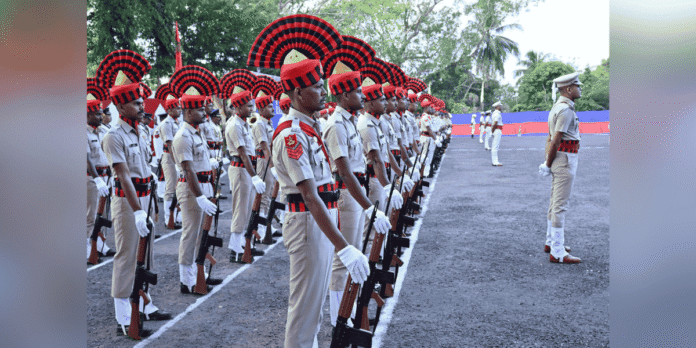
The Andaman and Nicobar Police has taken a significant administrative step by approving the introduction of Special Grade designations for Constables and Head Constables across multiple wings of the force, a move expected to reshape career progression for a large section of serving personnel. The decision applies to personnel serving in the A&N Police (Executive), Fire Service, Police Radio, PMT, PMF and the Indian Reserve Battalion.
Under the new framework, Constables who have completed 15 years of service as on January 1 of the relevant year and have already been granted the first Modified Assured Career Progression will be eligible to wear the designation of Head Constable (Special Grade). The change is aimed at formally recognising the experience, continuity of service and professional contribution of long-serving personnel who may otherwise face stagnation in rank despite years of duty.
In addition, Head Constables who have completed 25 years of total service, including a minimum of five years in the rank of Head Constable, and who have received both the first and second MACP, will be eligible for upgradation to Assistant Sub-Inspector (Special Grade). This provision introduces an additional tier of professional recognition without altering the existing rank structure, offering eligible personnel enhanced status linked to service length and performance benchmarks.

Officials indicated that the decision will have a wide-ranging impact across the force. Approximately 85 percent of the Andaman and Nicobar Police is expected to be covered by the Special Grade framework, while around 57 percent of personnel are projected to benefit immediately based on completed service requirements. The move is seen as a measure that directly addresses long-standing concerns related to career stagnation, particularly among lower ranks.
The introduction of Special Grade designations is expected to influence morale, motivation and professional identity within the force. By formally acknowledging years of service through upgraded designations, the policy seeks to balance operational experience with structured career recognition, especially in a geographically challenging and operationally diverse Union Territory like the Andaman and Nicobar Islands.
While the designations confer enhanced professional standing, the administration has clarified that the detailed procedures and modalities for implementation are still under finalisation. These are expected to outline eligibility verification, effective dates, uniform insignia usage and administrative processes. Further communication on these aspects will be issued in due course.

The decision has been positioned as part of broader personnel welfare initiatives within the force, reflecting an emphasis on retention, motivation and institutional stability. The Andaman and Nicobar Police operates across remote islands and demanding environments, making continuity of experienced manpower a critical operational requirement.
Acknowledgment has been recorded at the institutional level for the administrative support that enabled the decision, particularly at the level of the territorial administration and police leadership. The initiative is being viewed internally as a structural reform rather than a one-time benefit, with long-term implications for service motivation and organisational cohesion.
With implementation details awaited, the Special Grade designation policy marks a notable shift in how experience and service longevity are formally recognised within the Andaman and Nicobar Police, setting the stage for changes in career perception among the rank and file in the months ahead.



