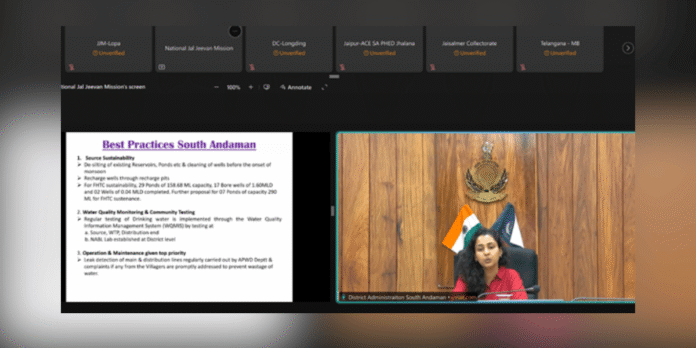
South Andaman’s approach to water security and community participation under the Jal Jeevan Mission came into national focus during the sixth District Collectors’ Peyjal Samvad organised by the Department of Drinking Water and Sanitation, where district administrations from across the country shared field-level innovations and implementation experiences.
At the virtual interaction, South Andaman highlighted a series of measures aimed at strengthening long-term sustainability of drinking water systems, even as the Jal Jeevan Mission moves into a phase that prioritises functionality and community ownership over rapid infrastructure creation. The district’s presentation reflected how localised solutions, public engagement and youth participation are being integrated into water governance in the islands.
Officials outlined that South Andaman has placed water security at the centre of its planning, supported by sustained efforts to protect and rejuvenate sources. Measures such as desilting of reservoirs, cleaning of wells and construction of 29 ponds with a combined storage capacity of 158.68 million litres were cited as key interventions to ensure long-term sustenance of functional household tap connections. Recharge wells and borewells have also been developed to buffer seasonal stress and variability in supply.

The administration underlined that many of these initiatives have emerged from direct engagement with local communities through Panchayati Raj Institution consultations and District Water and Sanitation Mission meetings. Feedback from residents has reportedly shaped interventions such as rejuvenation of local water sources, strengthening of check-weirs and community-driven protection of catchment areas, reinforcing the idea that local ownership is critical to system sustainability.
A distinctive feature of South Andaman’s approach, highlighted at the national forum, was the introduction of water audits conducted by school students. Using a standard assessment format, students identify instances of wastage within school premises and nearby households, creating early awareness about responsible water use. Officials described the initiative as both an educational tool and a behavioural change mechanism that extends conservation awareness beyond classrooms and into households.
Alongside infrastructure and audits, the district has relied heavily on Information, Education and Communication activities to build public consciousness around water conservation. Awareness rallies, street plays, print campaigns and a ‘Water Concert’ organised at Marina Park were cited as examples of how messaging has been blended with culture to reach wider audiences. These efforts were positioned as part of a broader attempt to embed water stewardship into everyday public life.

The South Andaman presentation formed part of a wider discussion at the Peyjal Samvad, which focused on the evolving direction of the Jal Jeevan Mission since its launch in 2019. Senior officials noted that while the initial years were devoted to achieving coverage targets, the emphasis has now shifted towards community-managed service delivery, systematic handover of schemes to Gram Panchayats and strengthening operations and maintenance at the local level.
The national dialogue also introduced Jal Utsav as a decentralised public engagement framework, with celebrations planned at national, State and Gram Panchayat levels. For districts like South Andaman, officials indicated that such platforms align with existing community outreach efforts and offer additional space to integrate local culture and traditions into water conservation messaging.
As the Jal Jeevan Mission prepares for its next phase, South Andaman’s experience was presented as an example of how island districts are adapting national programmes to local realities, combining infrastructure, community participation and behavioural change. The district’s initiatives, officials noted, reflect the broader shift towards ensuring that water systems remain functional, sustainable and community-owned well beyond the achievement of coverage milestones.


