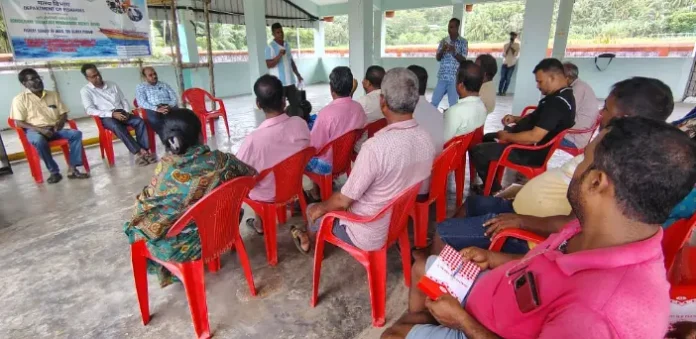
Sri Vijaya Puram, Aug 21: Improving the reliability and safe operation of fishing vessels was the focus of a two-day training programme at Guptapara, where 20 participants received practical instruction in maintaining, repairing and troubleshooting marine diesel engines to reduce the likelihood of breakdowns at sea.
The programme was organised by the Department of Fisheries, Andaman and Nicobar Administration, under the District Action Plan (DAP) 2026–27 of the Agricultural Technology Management Agency (ATMA) for South Andaman District. The department conducted the programme in association with the Fishery Survey of India (FSI), Zonal Base, Sri Vijaya Puram, at the Fish Landing Centre (FLC), Guptapara, Ferrargunj Block, on August 19 and 20.
The training focused on the importance of carrying out timely maintenance and handling marine diesel engines properly to maintain efficient operation and minimise the chances of mechanical failures while fishing vessels are at sea.

Technical support for the programme came from B. Balanayak, Mechanical Marine Engineer, and other officials of the FSI, along with representatives of the Department of Fisheries and Sagar Mitras.
Participants received hands-on guidance covering routine engine maintenance, basic repair work, troubleshooting and safe operating practices. The training was aimed at strengthening participants’ practical understanding of the engines used in fishing vessels and enabling them to apply appropriate maintenance and repair practices during their regular fishing activities.
The practical component of the programme focused on the basic skills required to identify and address engine-related issues, alongside routine maintenance measures. Participants were also guided on safe operation of marine diesel engines.
The programme formed part of the South Andaman District’s DAP under ATMA for 2026–27 and brought together technical personnel and fishing-sector representatives for focused training on marine engine maintenance.

At the conclusion of the two-day programme, all 20 participants received training certificates and tools following successful completion of the course.
The certificates and tools were distributed to encourage the participants to use the knowledge and practical skills acquired during the training in their day-to-day fishing activities.
The programme thus combined technical instruction with practical training, focusing on preventive maintenance, basic repairs, troubleshooting and safe engine operation for marine diesel engines used aboard fishing vessels.