A resident of Sippighat in the Andaman and Nicobar Islands has established a small yet profitable quail farming enterprise after receiving scientific training from the government poultry farm, demonstrating how limited urban space can be converted into a sustainable livelihood opportunity.
Prem Rao, who has long been interested in livestock activities, launched the venture after completing a one-month training programme in poultry farming at the Government Poultry Farm, Dollygunj, located within the Livestock Farm Complex and managed by the Department of Animal Husbandry and Veterinary Services under the Andaman and Nicobar Administration.
The training programme introduced participants to scientific methods of poultry management, including quail rearing, breeding practices, health care, and marketing strategies. According to officials, the programme was designed to equip farmers with the technical knowledge required to establish small-scale poultry ventures capable of generating regular income.

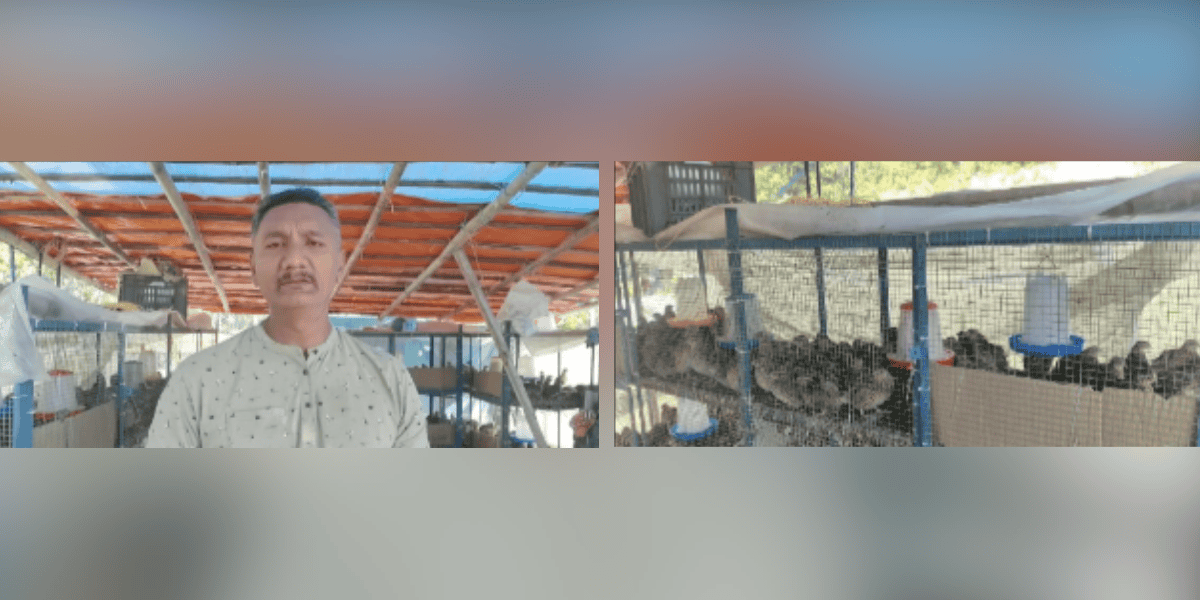
After completing the training, Rao faced a challenge common to many residents in semi-urban areas of the islands, limited land availability. Instead of abandoning the idea, he converted the terrace of his house into a compact quail farming unit.
To make efficient use of the restricted space, he constructed a small room on the rooftop and installed rack-type cages that allow multiple layers of birds to be managed vertically. The system enabled him to optimise the available area while maintaining proper care and monitoring of the birds.
Rao initially procured quail chicks from the Central Hatchery, Dollygunj, gradually expanding his flock as he gained experience in managing the birds. Over time, the small rooftop facility developed into a productive unit that now houses around 300 quails.
Under the current arrangement, male quails are sold in the local market at a price of ₹60 per bird, while female birds are retained primarily for egg production. The unit produces approximately 200 eggs every day, which are sold at ₹5 per egg, providing a steady income stream for the household.
Officials say the enterprise demonstrates how scientific training combined with innovative space utilisation can help small farmers develop viable livelihood activities even in areas where land resources are limited.
The terrace-based model adopted by Rao requires minimal land and allows easy monitoring of the birds. It also supports better feeding management and biosecurity practices, making it suitable for replication in residential areas or locations where conventional farming space is unavailable.
Rao said the training programme played a critical role in enabling him to start the venture. According to him, the technical guidance received during the course provided the practical knowledge needed to establish and manage the quail unit.

The Department of Animal Husbandry and Veterinary Services continues to organise training programmes and provide technical support to farmers across the islands in an effort to promote livestock-based livelihoods and strengthen rural income opportunities.
Officials noted that such initiatives are intended to encourage farmers to adopt scientific farming methods and diversify their sources of income through small-scale livestock activities.
Rao’s experience illustrates how training, innovation, and effective use of available space can convert small-scale poultry farming into a sustainable enterprise. Authorities say the example could motivate other aspiring farmers in the Andaman and Nicobar Islands to explore similar ventures using scientific techniques and locally available resources.