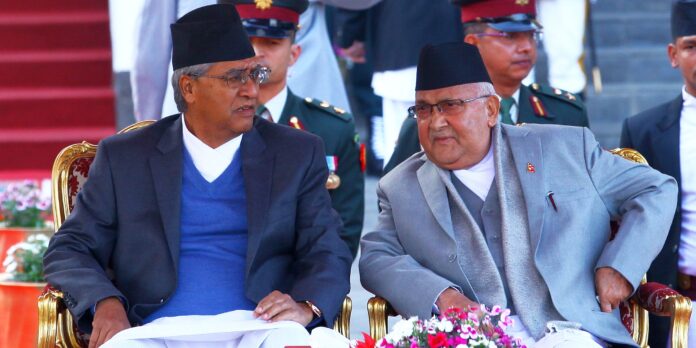
Former Nepal Prime Minister Sher Bahadur Deuba will not contest the upcoming House of Representatives election scheduled for March 5, bringing to a close a parliamentary career that has spanned more than three decades and shaped much of Nepal’s post-democracy political landscape.
The announcement was made on Tuesday by Deuba’s secretariat, with his chief personal secretary Bhanu Deuba stating on social media that the Nepali Congress president and former prime minister would not be entering the electoral race. The decision signals a decisive shift in Nepal’s evolving political order, where long-dominant leaders are facing mounting pressure from internal party revolts and a wider generational churn.
Deuba’s withdrawal marks the end of a political journey that began in 1991, when he was first elected to Parliament from Dadeldhura district in far-western Nepal following the restoration of multiparty democracy. Since then, Deuba had been continuously elected to the House of Representatives or Constituent Assembly, winning seven consecutive elections and establishing himself as one of the most enduring figures in Nepal’s national politics.
Over the years, Deuba served five terms as Prime Minister — in 1995, 2001, 2004, 2017 and 2021 — positioning him alongside CPN (UML) chairperson K P Sharma Oli and Nepali Communist Party coordinator Pushpa Kamal Dahal ‘Prachanda’ as one of the three leaders who dominated Nepal’s political scene for decades. His repeated returns to power reflected both his resilience and the fragmented nature of Nepal’s coalition-driven politics.
In recent months, however, a series of political setbacks steadily eroded Deuba’s influence. Although he was already barred by party statute from seeking another term as Nepali Congress president, he had continued to harbour ambitions of returning to the premiership. Those hopes were linked to a 2024 power-sharing agreement between the Nepali Congress and the CPN (UML), under which K P Sharma Oli and Deuba were expected to serve as Prime Minister on a rotational basis until the next general elections in 2027.
That arrangement unravelled in September last year when a Gen-Z-led political revolt brought down the Oli government, delivering a significant blow to Deuba’s prospects of reclaiming the top office for a sixth time. The movement, driven by younger voters and activists demanding generational change, has since reshaped political calculations across parties.
Deuba’s position weakened further in early January when the Nepali Congress elected new leadership under Gagan Thapa through a Special General Convention held despite Deuba’s opposition. The Election Commission’s recognition of the Thapa-led leadership effectively sidelined Deuba and pushed his faction into a defensive corner, leaving the Supreme Court as the only avenue for challenging the internal power shift.
As senior leaders and long-time loyalists began defecting to the Thapa camp, the former prime minister’s space within the party narrowed sharply. The decision not to contest the parliamentary election appears to be both a political retreat and a strategic move to prevent a formal split within the Nepali Congress at a time of intense internal reorganisation.
The Thapa-led Central Working Committee has since selected Nain Singh Mahar, a Deuba loyalist, from the constituency Deuba had represented for 34 years. The move has been interpreted as an attempt to accommodate Deuba supporters while consolidating the authority of the new leadership.
Deuba’s exit comes at a moment when Nepal’s traditional political elite are being challenged by a new generation of leaders and voters questioning the prolonged dominance of familiar faces. While Oli has managed to retain control of his party through re-election as chairperson, Prachanda has sought to reinforce his relevance by forging alliances with smaller leftist groups and overseeing a recent party merger.
With Deuba stepping aside, the path for his return to power through electoral politics has effectively closed. His withdrawal underscores the shifting balance within Nepal’s major parties and raises broader questions about how long-established leaders will navigate an era increasingly defined by demands for renewal, accountability and generational change.