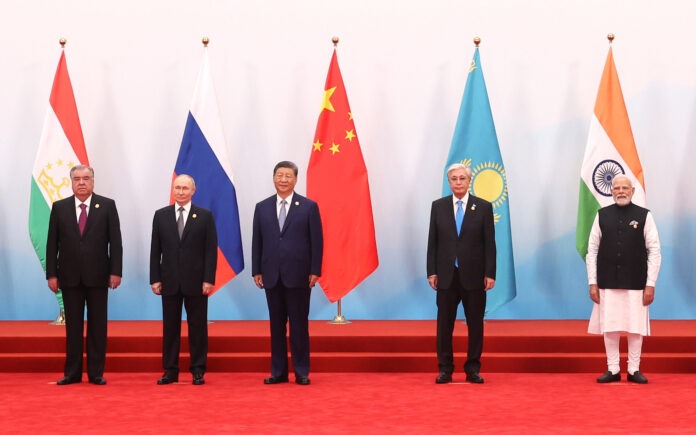
The 25th meeting of the Shanghai Cooperation Organisation (SCO) Council of Heads of State in Tianjin on Monday showcased both shared aspirations for regional stability and clear differences among member states, particularly on connectivity projects. Chinese President Xi Jinping used the platform to caution against “Cold War mentality and bullying,” while Prime Minister Narendra Modi underlined India’s priorities on security, connectivity and opportunity, even as New Delhi once again declined to endorse China’s Belt and Road Initiative (BRI).
Addressing the gathering, Xi urged member nations to promote fairness, justice and inclusivity in global governance. “We must uphold a correct view of World War II history and oppose Cold War mentality, block confrontation, and bullying,” he said, in remarks widely interpreted as a signal to the United States. He stressed support for the United Nations-led multilateral system and advocated for a more “just and reasonable” global governance order. Xi also called for strengthening SCO mechanisms, expediting new security and narcotics control centres, and establishing a development bank to bolster economic cooperation.
Highlighting the “Shanghai Spirit” of mutual trust and benefit since the organisation’s founding in 2001, Xi urged members to respect differences, expand cooperation, and enhance cultural exchanges. He described the SCO as a platform to “build a garden of civilisations where self-improvement, mutual benefit, and harmonious coexistence flourish.”
Prime Minister Modi, who concluded his two-day visit to China and emplaned for New Delhi after the summit, focused his address on fighting terrorism, strengthening connectivity, and exploring new opportunities for collaboration. He thanked member nations for their solidarity after the Pahalgam terror attack and reiterated that there must be “no double standards” in tackling terrorism. Modi urged coordinated action against terror financing and radicalisation, adding that perpetrators and supporters of cross-border terrorism must be held accountable.
On connectivity, Modi emphasised India’s backing for projects like Chabahar Port and the International North-South Transport Corridor, while highlighting innovation, youth empowerment and cultural exchange as areas ripe for deeper SCO collaboration. He proposed setting up a Civilisational Dialogue Forum under the grouping to promote people-to-people ties. Modi also expressed support for SCO’s reform agenda, including new centres to counter organised crime, cyber threats and drug trafficking, and called for a parallel effort to reform global institutions such as the United Nations.
Despite broad agreement on many issues, India once again withheld support for China’s BRI, becoming the only SCO member to do so. The Tianjin Declaration recorded the endorsement of the initiative by Belarus, Iran, Kazakhstan, Kyrgyzstan, Pakistan, Russia, Tajikistan and Uzbekistan, noting efforts to align it with the Eurasian Economic Union. India, however, reiterated its consistent position that connectivity initiatives must respect sovereignty, territorial integrity and universally recognised international norms. New Delhi has repeatedly protested the inclusion of the China-Pakistan Economic Corridor, which passes through parts of Ladakh and Jammu & Kashmir under Pakistan’s occupation, as a flagship BRI project.
The summit also produced joint statements emphasising the importance of strengthening global economic governance, safeguarding multilateral trade under World Trade Organisation principles, and opposing unilateral coercive measures that undermine fair competition and international cooperation. Member states reaffirmed adherence to the UN Charter, the SCO Charter and the principle of mutual respect for sovereignty.
The Tianjin Summit concluded with the adoption of the Tianjin Declaration and the announcement of Kyrgyzstan assuming the next SCO Presidency. With members pledging to deepen security and economic ties while navigating sharp differences, the summit reflected both the potential and the challenges of a forum that spans nearly half of Eurasia.