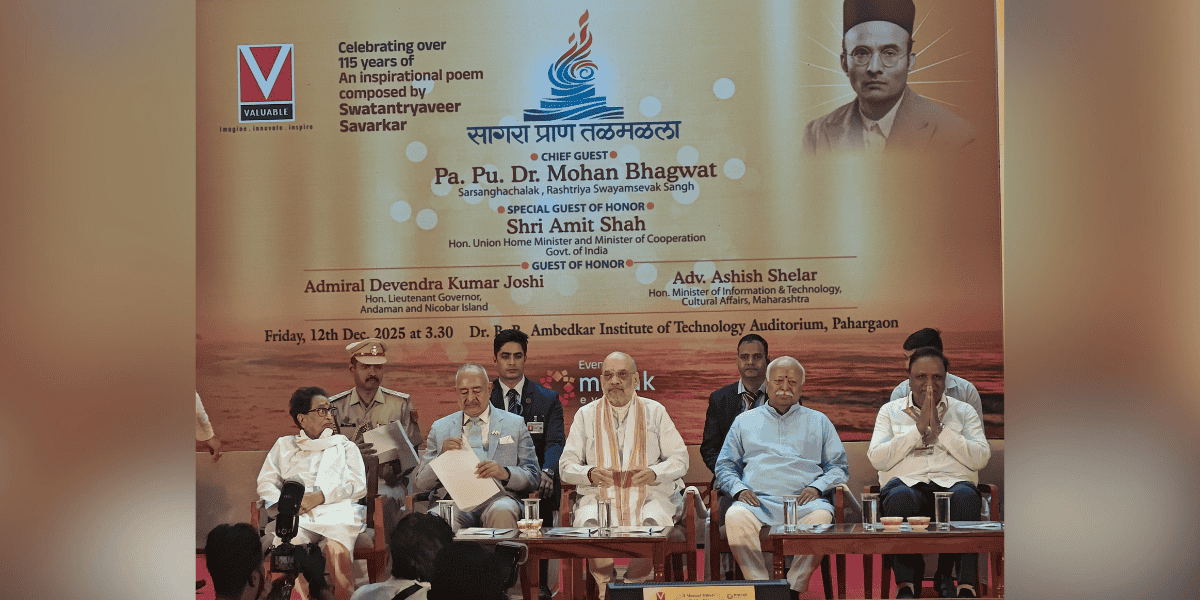
More than a century after it was penned on the shores of the Brighton, Swatantryaveer Vinayak Damodar Savarkar’s iconic poem “Ne Majasi Ne Parat Matrubhumila… Sāgara Pran Talamalala” took centre stage on Friday at a grand commemorative programme in Sri Vijaya Puram, marking 116 years of its creation.
The unveiling of the Savarkar’s bust, held at Beodanabad overlooking the sea that once bore silent witness to Savarkar’s imprisonment, sought to revisit the emotional and historical significance of the poem, which emerged from the Cellular Jail as a powerful expression of longing, resistance and unwavering love for the motherland. Organised by the Valuable Group, the programme drew political leaders, cultural figures and scholars, but remained anchored in Savarkar’s literary legacy.
The poem, has long been regarded as one of the most evocative works of patriotic literature in India. Its imagery of the sea as both witness and messenger of a prisoner’s yearning for freedom continues to resonate across generations. Speakers at the event repeatedly returned to the poem’s relevance, describing it as a bridge between personal suffering and collective national aspiration.

Union Home Minister Amit Shah, addressing the gathering, reflected on Savarkar’s role as a thinker and writer who redefined the narrative of India’s freedom struggle. Referring to Savarkar’s writings, Shah noted that his literary work was inseparable from his political thought, and that his interpretation of the 1857 uprising as a freedom struggle rather than a mere revolt reflected the same spirit of self-respect and national consciousness found in “Sāgara Pran Talamalala.” He said Savarkar’s dream of a strong and self-confident India continued to guide the nation’s journey towards 2047.
RSS Sarsanghachalak Mohan Bhagwat highlighted the cultural and social dimensions of Savarkar’s legacy, stressing that works like “Sāgara Pran Talamalala” were not just poems, but reflections of values rooted in language, self-reliance and cultural continuity. He urged families to preserve their mother tongues and ensure that India’s traditions remain alive and meaningful in everyday life.
The cultural segment of the programme formed the emotional core of the evening. Padma Shri Hridaynath Mangeshkar – only man in the room who met and lived with Savarkar during his childhood, along with Usha Mangeshkar and his team, presented a special rendition of “Ne Majasi Ne Parat Matrubhumila, Sāgara Pran Talamalala,” drawing sustained applause. Other compositions written by Savarkar and later set to music by Hridaynath Mangeshkar, including “Jayostute,” “Jai Jai Shivraya,” and “He Hindu Nrisingha,” were also performed, underscoring Savarkar’s profound contribution to India’s cultural and literary heritage.

Admiral Devendra Kumar Joshi, Lieutenant Governor of the Andaman and Nicobar Islands, and Maharashtra’s Cultural Affairs and IT Minister Ashish Shelar were present at the programme, along with actors Randeep Hooda and Sharad Ponkshe, historian Vikram Sampath, and other eminent personalities associated with the study and dissemination of Savarkar’s work.
Speaking on the occasion, Ameya Hete, founder of the Valuable Group, said the objective of the event was to bring Savarkar’s poetry back into public consciousness, particularly for younger generations. He said “Sāgara Pran Talamalala” remains a timeless reminder of the emotional cost of freedom and the enduring bond between the individual and the nation.
As the evening concluded by the sea, the words written 116 years ago echoed once again in the very landscape that inspired them, reaffirming the poem’s place as one of the most enduring expressions of India’s freedom struggle.