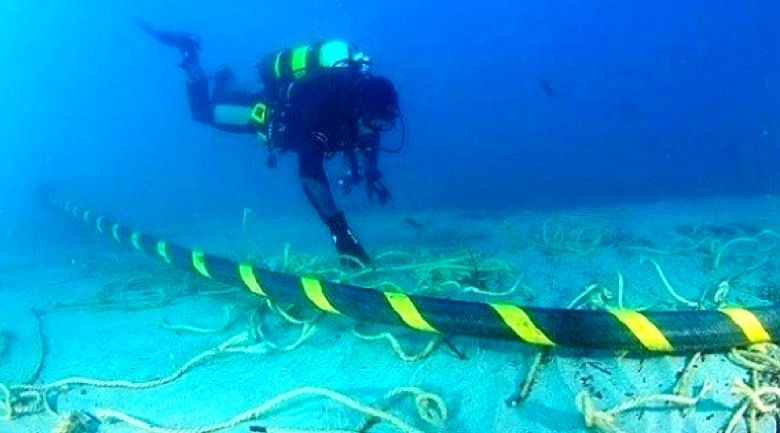
Sri Vijaya Puram: The government is examining a proposal to lay a second submarine optical fibre cable linking mainland India with the Andaman and Nicobar Islands as part of efforts to strengthen the region’s internet backbone and expand connectivity across the archipelago.
The proposed cable would run from Puri, a coastal city in Odisha on India’s eastern seaboard, to the Andaman and Nicobar Islands. The link would complement the existing Chennai–Andaman and Nicobar Islands (CANI) submarine cable, which currently serves as the primary digital connection between the islands and mainland India.
Officials say the additional cable could provide a crucial backup route for internet traffic while also helping extend fibre connectivity to more islands in the archipelago.
The proposal was highlighted by Dr. B.S. Murthy, Principal General Manager of Bharat Sanchar Nigam Limited (BSNL), during an interaction with media delegates visiting the CANI office in Sri Vijaya Puram.
Murthy said the new cable would function as a second backbone route, improving the reliability of digital communications to the islands.
In geographically isolated regions such as the Andaman and Nicobar Islands, submarine fibre cables serve as the main digital lifeline connecting residents, businesses and government services with the mainland.
Murthy explained that the additional cable would improve network resilience by providing redundancy, meaning connectivity can continue even if one cable faces disruptions due to technical faults, maintenance work or marine activity.
Officials also indicated that the new route could help extend fibre connectivity to islands that are currently outside the existing network.

Strategic digital backbone
At the same time, BSNL officials emphasised that the existing CANI submarine cable still has substantial unused bandwidth capacity.
Murthy explained that submarine fibre cables are capable of carrying extremely large volumes of data and that the internet speeds available to users are largely determined by the transmission equipment installed at the cable landing stations rather than by the cable itself.
By upgrading this equipment with newer technology, telecom operators can significantly increase the amount of data transmitted through the same cable infrastructure without replacing the fibre.
Murthy described the CANI cable system as a long-term infrastructure asset capable of supporting the islands’ connectivity needs for many years through periodic technological upgrades.
The network currently operates through four separate fibre lines linking the mainland and the islands. One cable is used for public telecommunications services, while another is dedicated to defence communication requirements. The remaining lines act as reserve cables to ensure uninterrupted connectivity in case of technical failures.
At present, the fibre network connects seven islands through Sri Vijaya Puram, which serves as the central hub for distributing internet and telecom traffic to other parts of the archipelago. From there, connectivity is extended to different islands through additional terrestrial fibre links and local infrastructure.
Officials say strengthening digital connectivity has also acquired strategic significance for the islands. Apart from civilian use, the Andaman and Nicobar Islands host key naval and defence installations and serve as India’s forward maritime outpost in the Bay of Bengal and the wider Indo-Pacific region.
The islands are also expected to see major infrastructure developments in the coming years, including the proposed international transshipment port at Great Nicobar and other initiatives linked to maritime trade and logistics.
With these developments, reliable high-capacity internet connectivity is increasingly being viewed as essential infrastructure. Officials say robust fibre connectivity will support governance, defence communication, logistics management and commercial activities linked to India’s expanding maritime ambitions.
In this context, improved digital connectivity is also seen as a key requirement for integrating the Andaman and Nicobar Islands into the broader blue economy that India aims to develop across the Indian Ocean region.
Murthy also addressed the growing discussion around satellite-based internet services offered by private global operators.
While acknowledging the technological capabilities of satellite internet, he said such systems generally involve significantly higher operational costs compared with submarine fibre networks.
Satellite services require large satellite constellations, ground stations and continuous operational management, which increases the overall cost of providing connectivity.
Submarine fibre cables, by contrast, require substantial investment during installation but operate at comparatively lower recurring costs once deployed.
This makes fibre networks a more cost-effective solution for delivering high-capacity internet connectivity in geographically dispersed regions such as the Andaman and Nicobar Islands.

The islands had historically relied on satellite communication before the commissioning of the CANI submarine cable network.
The introduction of fibre connectivity significantly improved internet speeds and reliability across several islands, enabling faster communication and expanding the scope of digital services in governance, education, healthcare and tourism.
However, extending high-speed connectivity to all inhabited islands remains challenging due to the vast sea distances between islands and the technical complexities involved in laying submarine cables in remote maritime zones.
Officials believe the proposed Puri–Andaman submarine cable, if implemented, could further strengthen the islands’ digital infrastructure while enabling broader access to high-speed internet across the archipelago.