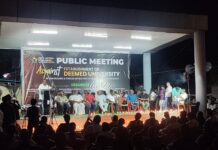
A block-level training programme aimed at strengthening grassroots governance was conducted at the Panchayat Community Hall of Gram Panchayat Pokadera under the aegis of CD Block Mayabunder. The programme focused on orienting elected representatives on the principles, objectives and functional responsibilities of Panchayati Raj Institutions, with an emphasis on effective local governance and democratic participation.
The training was organised as part of a structured initiative titled “Strengthening Local Governance: Training of Elected Representatives on the Principles and Objectives of Panchayati Raj Institutions,” identified as Theme–8 under the ongoing capacity-building efforts for PRI members. Elected representatives from the block participated in the programme, which sought to enhance their understanding of constitutional provisions, administrative roles and development-linked responsibilities entrusted to local bodies.
During the session, an overview of various government schemes relevant to Panchayati Raj Institutions was presented, outlining how elected representatives can play a facilitative role in implementation and monitoring at the grassroots level. The presentation also covered the constitutional mandate governing PRIs, highlighting their objectives, powers and functions within the framework of decentralised governance. Emphasis was placed on aligning local decision-making with broader development goals while ensuring accountability and transparency.

To encourage active participation, a chart-based activity was conducted as part of the training. This interactive component was designed to move beyond theoretical inputs and enable PRI members to engage practically with governance-related concepts. Participants were encouraged to analyse roles, responsibilities and institutional linkages through visual tools, allowing for clearer understanding and peer-level discussion.
The programme also underscored the importance of informed and proactive leadership at the village and block levels. The role of elected representatives in upholding democratic values, responding to community needs and ensuring inclusive development was highlighted as central to the functioning of Panchayati Raj Institutions. The training sought to reinforce the idea that effective local governance depends not only on institutional frameworks but also on the capacity and commitment of those entrusted with leadership roles.
Addressing the participants, the Block Programme Manager highlighted the significance of strong local governance systems in translating policies into tangible outcomes for communities. The address focused on the responsibility of elected representatives to act as a bridge between government programmes and citizens, ensuring that welfare measures and development initiatives reach intended beneficiaries without delay or distortion.
The programme reflected ongoing efforts by the administration to build institutional capacity at the grassroots level through targeted training and orientation initiatives. Such programmes are intended to equip PRI members with the knowledge and tools required to navigate administrative processes, engage constructively with line departments and address local issues more effectively.

Participants were encouraged to apply the learning from the training in their respective jurisdictions, particularly in planning, implementation and monitoring of development works. The interactive nature of the session allowed PRI members to clarify doubts, share experiences and gain insights into best practices related to local governance.
The training concluded with an emphasis on continuity in capacity-building efforts, recognising that evolving governance challenges require sustained learning and adaptation. The programme at Pokadera formed part of a broader strategy to strengthen Panchayati Raj Institutions by empowering elected representatives with a clearer understanding of their constitutional role and functional responsibilities within the democratic framework.