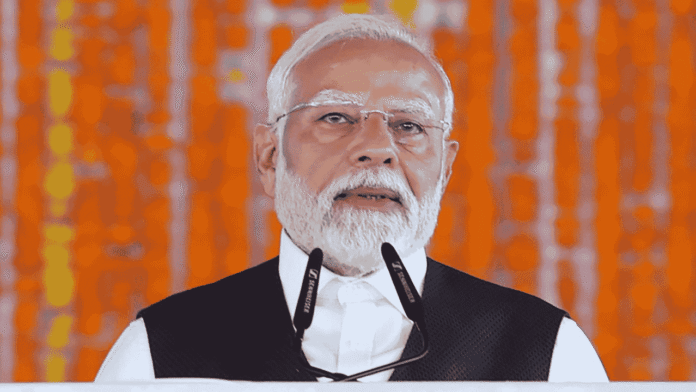
Prime Minister Narendra Modi on Tuesday warned that recent global crises have disrupted supply chains across critical sectors, stressing the need for resilient and secure systems in areas such as semiconductors, energy, and minerals.
Speaking after inaugurating Kaynes Semicon’s OSAT facility in Sanand, the Prime Minister said that developments in the 21st century, including the Covid-19 pandemic and ongoing global conflicts, have significantly affected the movement of goods and raw materials worldwide. He noted that essential sectors such as semiconductor chips, rare earth minerals, and energy supplies have faced disruptions due to these challenges.
He said that any break in supply chains directly impacts global development, underlining the urgency for countries to strengthen continuity in critical sectors. He added that India must position itself as a leader in building resilient supply systems to safeguard future growth.

The Prime Minister referred to India’s policy response during the pandemic, highlighting a strategic push towards self-reliance. He said the country has worked to emerge as a global hub in semiconductors, while also advancing in sectors such as artificial intelligence, clean energy, electric vehicles, defence, and electronics.
Citing policy initiatives, he pointed to the India Semiconductor Mission, launched in 2021, as a key step reflecting the country’s ambition to build domestic capacity. He said the initiative represents a broader assertion of national confidence and has already begun to show results.
According to the Prime Minister, ten semiconductor projects worth Rs 1.6 lakh crore are currently underway across six states. These include projects led by companies such as Kaynes Semicon and Micron Technology, forming part of a wider push to strengthen manufacturing capabilities.
He said the next phase, India Semiconductor Mission 2.0, announced in the Union Budget, will focus on building domestic capacity for semiconductor materials and equipment. The goal is to establish a complete, end-to-end semiconductor ecosystem within the country.
The Prime Minister also highlighted India’s efforts to secure critical mineral supply chains through global partnerships, including participation in Pax Silica. He said the government has launched the National Critical Minerals Mission to strengthen mining and production capabilities for essential resources.
As part of these efforts, a Rs 1,500 crore scheme has been introduced to support the recycling of minerals. He added that a rare earth corridor spanning Odisha, Andhra Pradesh, Tamil Nadu, and Kerala will integrate mining, refining, and manufacturing operations to streamline supply chains.

He further stated that India is building a national repository of critical minerals and executing these initiatives in a mission-driven approach to address long-term resource security.
Reflecting on the timeline of such initiatives, the Prime Minister said earlier action could have accelerated progress but emphasised that current efforts are being implemented with urgency. He described the present decade as a crucial period for India’s development trajectory.
The remarks underscore a broader policy focus on reducing external dependencies and strengthening domestic capabilities in strategic sectors amid ongoing global uncertainties.