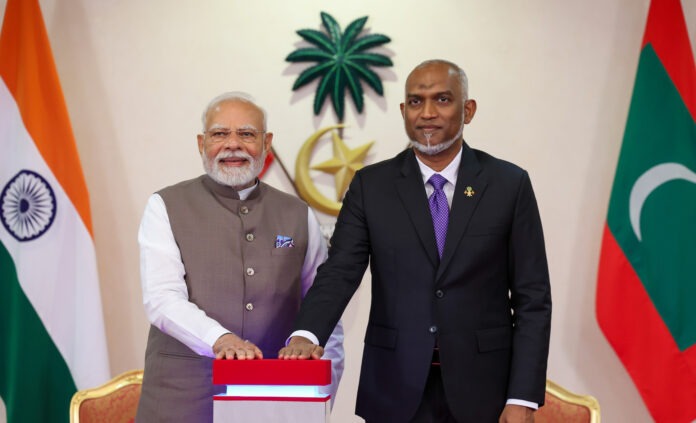
New Delhi: Prime Minister Narendra Modi’s recent visit to the Maldives has been described as a calibrated strategic move by India, combining diplomatic outreach with concrete economic and security measures to counter China’s growing footprint in the Indian Ocean Region (IOR). The two-day state visit in July marked both a symbolic reset in bilateral ties and a substantive shift in regional dynamics.
At the invitation of Maldivian President Mohamed Muizzu, Modi attended the island nation’s Independence Day celebrations in Male as the Guest of Honour. The visit came amid a reset in India-Maldives relations, following months of diplomatic tension and China’s quiet manoeuvring in the region. Analysts now view the outreach as part of a broader strategic reassertion by New Delhi in a maritime neighbourhood increasingly shaped by geopolitical competition.
India’s pledge of a ₹4,850 crore Line of Credit to the Maldives, coupled with a debt relief package, underscored the shift from symbolism to strategic statecraft. The financial aid, extended in Indian rupees, is being seen as a direct contrast to China’s foreign lending practices, often criticised for burdening small nations with unsustainable debts under opaque terms. By offering credit in its own currency, India also reduces dependence on the US dollar, strengthening bilateral economic interdependence.
In addition to economic support, Modi’s visit also reaffirmed India’s commitment to enhancing the capacity of Maldivian security forces. New Delhi will provide training, equipment, and operational support to help Male navigate its growing maritime security concerns. This defence collaboration serves as a counter to China’s military agreements in the region and reinforces India’s longstanding role as a net security provider in the Indian Ocean.
The Maldives, despite its size, holds significant strategic weight due to its proximity to key sea lanes through which a large share of global oil and trade flows. India’s renewed engagement reasserts its intent to safeguard these maritime routes while limiting the reach of China’s so-called “string of pearls” strategy, a network of Chinese military and commercial outposts across the IOR.
The visit also marks a deeper push under India’s ‘Neighbourhood First’ and SAGAR (Security and Growth for All in the Region) doctrines. While China often takes a transactional approach to diplomacy, India’s engagement has focused on inclusivity, long-term cooperation, and mutual respect. Analysts believe this is gaining traction among smaller nations that are increasingly wary of Beijing’s aggressive tactics and financial conditionalities.
According to a report by India Narrative, Modi’s diplomacy highlights a more sophisticated understanding of statecraft, where soft power tools such as cultural exchange, financial transparency, and collaborative security are preferred over coercive methods. The report suggests that India’s generosity, patience, and multi-dimensional approach have slowed China’s strategic advance in the Maldives.
India’s evolving partnership with the Maldives goes beyond symbolic gestures. It represents a critical shift in how New Delhi seeks to secure its strategic interests while promoting regional stability. For the Maldives, the benefits of Indian partnership lie not only in aid and defence but in a model of cooperation that respects sovereignty and supports sustainable development.
Observers also note that smaller nations like the Maldives have historically balanced ties between larger powers to maximise their national interests. However, India’s approach, grounded in respect, reliability, and realpolitik, is emerging as a viable and preferable alternative.
The visit and its outcomes are being interpreted as a long-term investment in regional stability, rather than a reactive counter to China. By combining strategic intent with tangible support, India is positioning itself not just as a regional partner but as a responsible power capable of shaping the Indian Ocean order.
As global power equations continue to evolve, the Maldives visit signals that India is no longer content with playing defence in its backyard. Instead, it is carving out a leadership role with pragmatic diplomacy and assertive engagement, a blend that could define its foreign policy template in the years ahead.