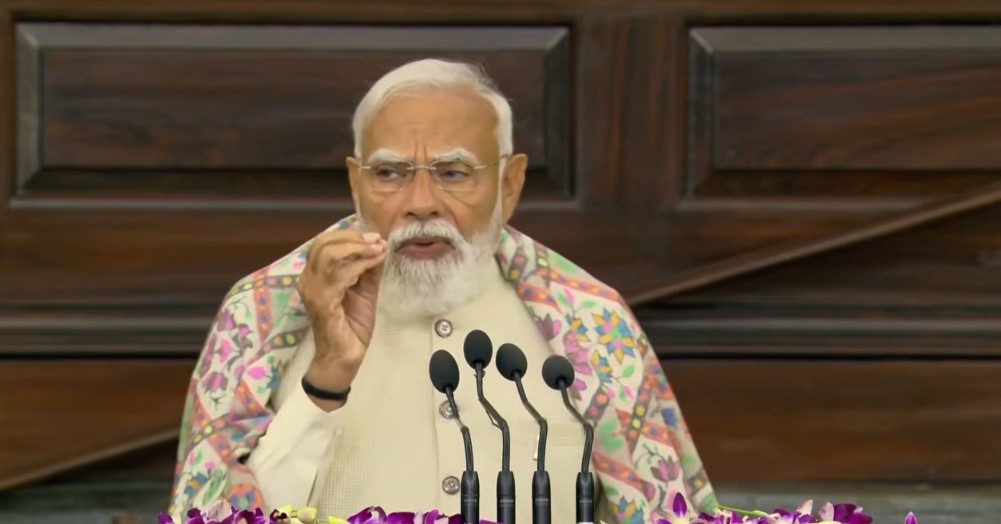
Prime Minister Narendra Modi on Thursday underscored the need for the Global South to chart new development pathways, asserting that India has consistently raised its concerns on every major global platform. Inaugurating the 28th Conference of Speakers and Presiding Officers of the Commonwealth (CSPOC) at the Samvidhan Sadan in the Parliament House Complex, Modi said the world is undergoing unprecedented transformation and that democratic institutions must adapt through cooperation, innovation and inclusivity.
Addressing delegates from across the Commonwealth, the Prime Minister recalled India’s G20 Presidency, noting that the priorities of the Global South were placed at the centre of the global agenda. He said India has worked to ensure that innovation and technological progress benefit not just its own citizens but also partner nations, particularly within the Commonwealth and developing regions.
The three-day conference, being held from January 14 to 16, is chaired by Lok Sabha Speaker Om Birla and has drawn a record 61 Speakers and Presiding Officers from 42 Commonwealth countries, along with representatives from four semi-autonomous parliaments. It is the largest gathering in the history of the forum. Discussions are focused on contemporary parliamentary challenges, including the use of artificial intelligence in legislative functioning, the impact of social media on lawmakers, citizen engagement beyond elections, and the security and well-being of members of Parliament and staff.

Modi highlighted India’s efforts to build open-source digital platforms, saying such systems are being developed to allow partner countries to replicate and adapt technologies used in India. He described this approach as part of India’s commitment to shared growth and strengthening democratic institutions globally. The Prime Minister also stressed the role of presiding officers in connecting citizens with democratic processes and ensuring the smooth functioning of legislatures.
Referring to India’s democratic experience, Modi said the country’s diversity has emerged as a source of strength rather than a challenge. He cited the scale of the 2024 general elections, which involved nearly 980 million registered voters, over 8,000 candidates and more than 700 political parties, calling it the largest democratic exercise in human history. He also pointed to increased participation and leadership by women, noting that women hold half of leadership positions in local governance.

The Prime Minister highlighted India’s humanitarian outreach during the COVID-19 pandemic, when medicines and vaccines were supplied to more than 150 countries. He said this reflected India’s cultural ethos of viewing the world as one family and its belief in democracy as a means of inclusive development and last-mile delivery of welfare. Modi added that welfare initiatives have helped lift an estimated 25 crore people out of poverty.
Modi also outlined India’s economic position, describing the country as the fastest-growing major economy and the world’s fourth-largest economy. He cited achievements such as the expansion of the Unified Payments Interface, growth of the startup ecosystem, and advances in sectors including steel, aviation, railways and agriculture.
This is the fourth time India is hosting the CSPOC, after earlier editions in 1970–71, 1986 and 2010. The theme of the current conference is “Effective Delivery of Parliamentary Democracy.” Lok Sabha Speaker Om Birla, in his address, emphasised ethical use of artificial intelligence, combating misinformation and improving transparency through technology, aligning the discussions with the evolving demands on democratic institutions worldwide.