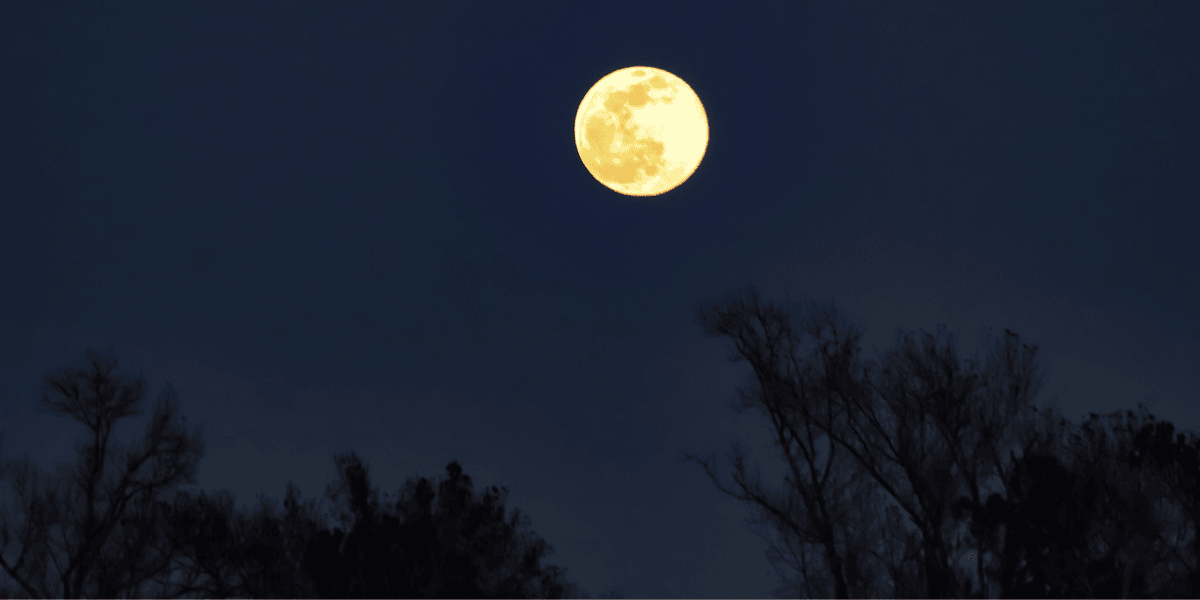
Paush Purnima, the first full moon of the Hindu lunar calendar in 2026, will be observed on Saturday, January 3, coinciding with the year’s first supermoon, popularly referred to as the Wolf Supermoon. The rare overlap of a significant religious observance and a notable astronomical event is expected to draw attention from devotees and skywatchers alike.
The Wolf Supermoon is set to illuminate the night sky with a brighter and slightly larger appearance than an average full moon. Astronomers explain that this phenomenon occurs when a full moon aligns closely with perigee, the point in the Moon’s elliptical orbit at which it is nearest to Earth. On January 3, the Moon will be positioned at a distance of approximately 362,000 kilometres from Earth, making it appear noticeably more prominent in the sky.
Due to this proximity, the Moon is expected to look around 6 to 14 per cent larger and nearly 13 to 30 per cent brighter compared to when it is at apogee, the farthest point in its orbit. The Moon will rise opposite the Sun in the constellation Gemini, marking the first full moon of 2026 and the first of three supermoons anticipated during the year.

Astronomically, a full moon occurs when the Moon is positioned directly opposite the Sun in Earth’s sky, allowing its entire visible surface to be illuminated. While this alignment takes place roughly once every 27 days, the exact moment of full illumination determines the official full moon. Although the Moon may appear full for a few nights before and after, peak illumination for this supermoon will occur on January 3.
According to Time and Date, the Wolf Moon is expected to rise at around 3:32 pm IST on Saturday. Observers may be able to witness its brilliance shortly after moonrise, depending on local weather conditions and horizon visibility.
The name “Wolf Moon” has its origins in Northern Hemisphere folklore, where midwinter nights were associated with wolves howling near villages. Over time, the term has come to be commonly used to describe the first full moon of the year, blending cultural tradition with astronomical identification.

Alongside its celestial significance, Paush Purnima holds deep religious and spiritual importance in Hindu tradition. The day is marked by rituals such as holy baths, fasting, prayers, and acts of charity. Devotees consider the Paush month especially auspicious for spiritual practices, particularly during the winter season.
As per traditional Hindu Panchang calculations, the Purnima Tithi began on the evening of January 2 and will conclude on the afternoon of January 3, making Saturday the primary day of observance. Across various regions, devotees are expected to gather at rivers and pilgrimage sites to perform ritual baths and prayers in accordance with long-standing customs.
The coincidence of Paush Purnima with the Wolf Supermoon adds a rare dimension to this year’s observance, blending faith, folklore, and astronomy. While devotees focus on spiritual observances, astronomy enthusiasts will have the opportunity to witness a striking lunar display, making January 3 a notable date on both religious and scientific calendars.