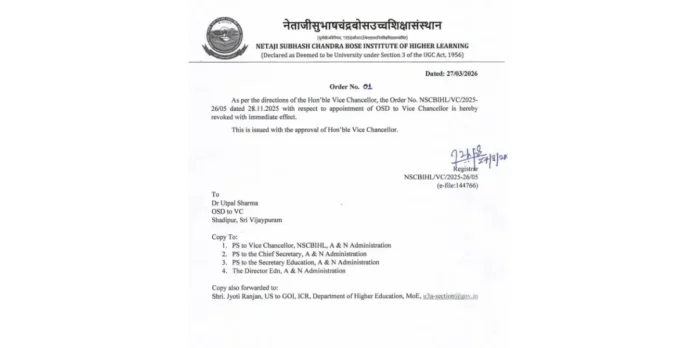
In a significant administrative move, the Netaji Subhash Chandra Bose Institute of Higher Learning (NSCBIHL) has revoked the appointment of the Officer on Special Duty (OSD) to the Vice Chancellor with immediate effect, formally ending the tenure of Utpal Sharma. The decision was issued through Order No. 01 dated March 27, 2026, by the Registrar following directions from the Vice Chancellor.
The order cancels an earlier directive dated November 28, 2025, under which Sharma had been appointed to the position. With the latest notification, the post of OSD to the Vice Chancellor stands withdrawn. The official communication states that the revocation has been approved by the Vice Chancellor and is effective immediately.
The order has been circulated to key administrative offices, including the Secretariat of the Vice Chancellor, the Chief Secretary of the Andaman and Nicobar Administration, and the Department of Education, indicating the administrative significance of the move.

The development follows a sequence of events that had placed the appointment under scrutiny. The appointment of Utpal Sharma as Officer on Special Duty at the institute had earlier been cancelled following a complaint raised by the Member of Parliament in February 2026. The decision was confirmed by the Ministry of Education and upheld by Vice-Chancellor Alok Rai, who maintained that the OSD position was not part of the university’s sanctioned structure.
The move effectively overturned the 2025 order issued under emergency provisions by then Vice-Chancellor Sunil Kumar Khare. That order had cited Clause 23, Sub-Clause C(2) of the University Grants Commission Regulations, 2023, to justify the appointment, invoking the Vice Chancellor’s authority to take decisions in urgent situations.
However, the present administration has taken a stricter view of these provisions, holding that such emergency powers cannot be used to create or fill posts that are not formally recognised within the institution’s statutory framework. According to this interpretation, the absence of a sanctioned provision for the OSD role rendered the appointment untenable.

The revocation marks an administrative shift and underscores a more rigid adherence to regulatory norms governing institutional appointments. It also reflects the evolving governance framework within NSCBIHL as it continues to define its operational and statutory boundaries as a deemed-to-be university.
The episode has drawn attention to the limits of discretionary authority in higher education institutions, particularly those still in the process of institutional consolidation. By rescinding the appointment and withdrawing the post, the institute has reinforced the requirement for formal statutory backing in administrative decisions.
The cancellation of the OSD position and the termination of Sharma’s role conclude a development that has raised questions about governance, regulatory compliance, and the scope of executive powers within emerging academic institutions.