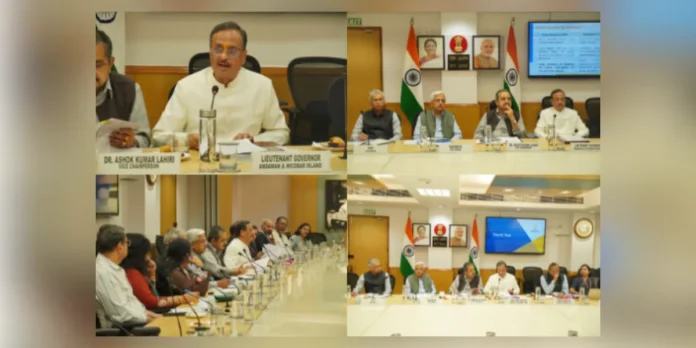
Sri Vijaya Puram, November 5: A series of infrastructure and public-service gaps affecting the Andaman and Nicobar Islands, including declining flight frequencies, high airfares, ageing water pipelines, healthcare shortages and delayed connectivity projects, came under discussion at a high-level meeting at NITI Aayog in New Delhi on November 4. Lieutenant Governor Dr. Dinesh Sharma presented a development roadmap, seeking greater flexibility in central schemes and time-bound decisions on pending proposals to address the islands’ geographical and logistical constraints.
The meeting, chaired by NITI Aayog Vice Chairman Ashok Kumar Lahiri, brought together NITI Aayog Member R. Subrahmanyam, CEO Anurag Jain, Chief Secretary Gyanesh Bharti, representatives of the Andaman and Nicobar Administration and secretaries from the Union ministries of Civil Aviation, Health, Jal Shakti, Tourism, Shipping, Fisheries, Road Transport and Highways, and Power.
A key concern raised was the additional financial burden arising from transporting construction materials and essential commodities from the mainland. The meeting sought flexibility in the cost norms and eligibility conditions of central government schemes, taking into account the specific requirements of the islands.

Connectivity featured prominently in the discussions, with the administration raising concerns over reduced flight frequencies and expensive airfares. The meeting also examined the need to expedite the upgradation of National Highway-4, construction of the Middle Strait Bridge, reconstruction of 13 jetties under Sagarmala 2.0 and improved regular cargo vessel services. The proposed projects in Great Nicobar also figured in the deliberations.
On essential services, discussions covered the replacement of ageing water supply pipelines under the Jal Jeevan Mission and improvements to water storage and distribution systems across 265 villages. Strengthening healthcare infrastructure, creating essential medical posts at ANIIMS, expanding MRI facilities and promoting renewable energy were among the other priorities considered.

The administration also highlighted opportunities to strengthen the island economy through better utilisation of deep-sea tuna resources, with a focus on employment generation and export potential. Tourism development at Netaji Subhas Chandra Bose Island, Viper Island and Swaraj Dweep was discussed alongside agricultural mechanisation, cold storage infrastructure and pending rural road proposals under PMGSY-IV.
Dr. Sharma called for an integrated, sustainable and time-bound development framework tailored to the islands. He urged NITI Aayog and the concerned Union ministries to take time-bound decisions on pending proposals, provide flexibility in scheme implementation, assign clear responsibilities to nodal departments and conduct regular high-level reviews.
The discussions placed the islands’ infrastructure, economic development and strategic requirements within the broader objective of achieving Viksit Bharat @2047, with emphasis on their role in India’s maritime boundaries, Indo-Pacific presence and maritime trade.