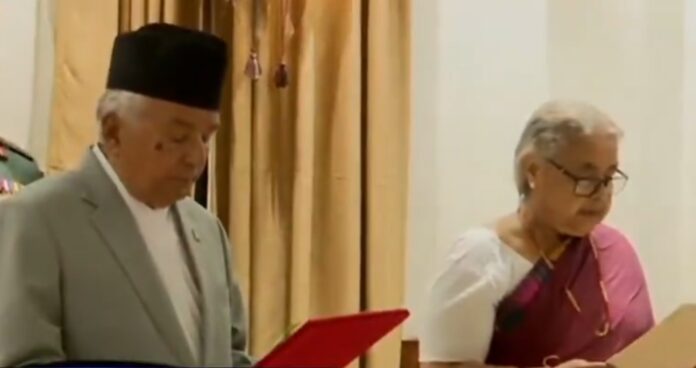
Nepal has appointed its first-ever woman Prime Minister, with former Chief Justice Sushila Karki sworn in late Fray as interim head of government. The decision came after days of violent Gen-Z protests that led to the fall of the KP Sharma Oli-led administration, leaving the Himalayan nation in political and constitutional uncertainty.
At 73, Karki takes on the role at a critical juncture. Her swearing-in by President Ram Chandra Poudel followed day-long consultations with protest leaders, constitutional experts, and the army chief. The Gen-Z protestors, who have been demanding sweeping changes in governance, agreed on Karki’s name after rejecting several other non-political figures.
The choice of Karki is historic but unconventional. Nepal’s Constitution explicitly requires the Prime Minister to be a member of the House of Representatives, disqualifying her since she does not hold elected office. Moreover, Article 132(2) bars former Chief Justices from assuming government positions. Her appointment has therefore been made under the “principle of necessity,” a practice invoked during previous crises in Nepal but one that many experts say undermines the rule of law.
Constitutional lawyer Bipin Adhikari noted that while the principle has been used since the 1950 revolution, it risks setting a dangerous precedent. He cautioned that bypassing constitutional safeguards could encourage future violations. Still, he acknowledged Karki’s record of integrity and her reputation for defending the Constitution, saying she could be trusted provided her tenure remains temporary and elections are held promptly.

Karki’s appointment has been welcomed across political and civic circles. Former Prime Minister Baburam Bhattarai called it “positive and appropriate” that Gen-Z protestors backed a capable and clean figure. Former Chief Justice Kalyan Shrestha also vouched for her leadership qualities. Supporters argue that her judicial background and history of landmark rulings against powerful figures make her uniquely placed to steer Nepal through turbulence.
Her rise comes against a backdrop of turmoil. Protests against Oli’s rule escalated into violent confrontations, leaving at least 51 people dead, including security personnel, and causing widespread destruction of public and private property. Protestors demanded accountability for corruption, better governance, and prosecution of those responsible for violence. Analysts say Karki’s immediate challenge will be restoring order, coordinating among fractious stakeholders, and preparing the ground for elections.
Born in 1952 in Biratnagar, Morang district, Karki pursued education at a time when few girls had access to schools. Inspired by her father, who was aligned with Nepali Congress leader B.P. Koirala studied law at Tribhuvan University and completed her Master’s in political science at Banaras Hindu University in India. Beginning her legal practice in 1979, she rose steadily, becoming a senior advocate in 2007 and a permanent Supreme Court judge in 2010. She made history in 2016 as Nepal’s first female Chief Justice.
Her judicial career was marked by both acclaim and controversy. In 2017, she delivered a landmark ruling disqualifying Lok Man Singh Karki, the powerful anti-corruption chief accused of abusing his authority. Yet she faced impeachment proceedings over another ruling related to the appointment of a police chief. Suspended briefly, she was later reinstated when the Supreme Court invalidated the impeachment motion. Earlier, in 2012, she convicted a sitting minister, Jaya Prakash Gupta, on corruption charges.
Her personal life also reflects Nepal’s turbulent political history. Her husband, Durga Subedi, was a Nepali Congress activist involved in the country’s first plane hijacking in 1973 to fund resistance against the Panchayat regime.
Karki’s appointment is widely seen as a temporary measure to stabilise the nation until elections are held. Her legacy as Prime Minister will likely hinge on her ability to maintain order, address protestors’ demands, and safeguard Nepal’s fragile constitutional framework while guiding the country through one of its most volatile transitions in decades.