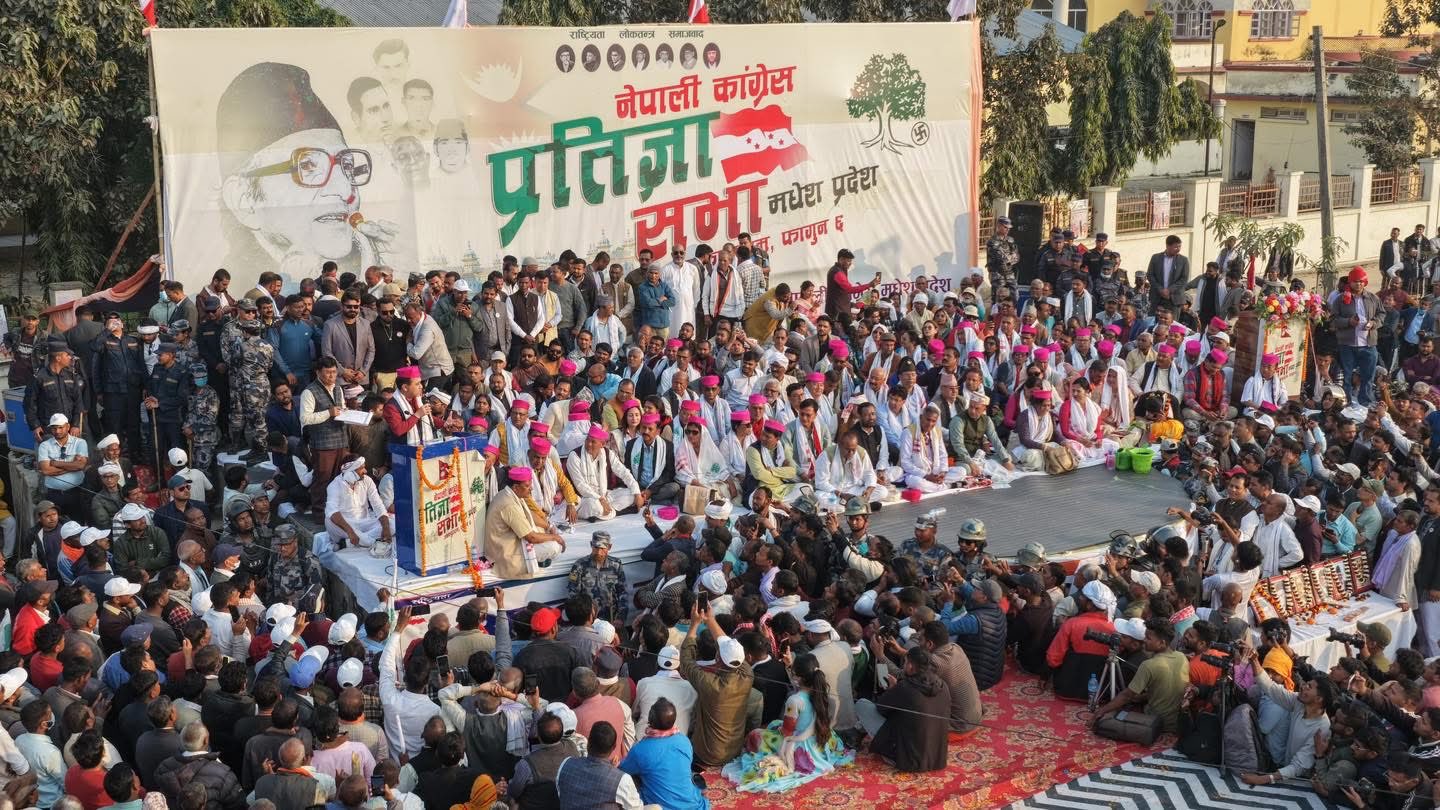
As Nepal moves closer to the March 5 general elections, the country’s major political parties have unveiled their election manifestos, placing strong emphasis on maintaining friendly relations with neighbouring countries amid shifting regional and global dynamics. Foreign policy priorities announced by the leading parties signal continuity in Nepal’s traditional diplomatic approach, alongside selective calls for strategic repositioning.
The three principal political forces, the Nepali Congress, the Communist Party of Nepal–Unified Marxist Leninist, and the Rastriya Swatantra Party, released their manifestos on Thursday, outlining distinct but overlapping visions for Nepal’s engagement with neighbours and the wider international community.
While the foreign policy outlooks of the Nepali Congress and the CPN-UML are largely familiar due to their history in governance, attention was focused on the manifesto of the Rastriya Swatantra Party, which is positioning itself as a contender to lead the next government. The party has named Balen Shah as its prime ministerial candidate.
In its manifesto, the RSP proposed a policy of “balanced and dynamic diplomacy,” stating its intent to reposition Nepal from a buffer state to a bridge between regional powers. The party underscored the importance of trilateral economic partnerships and improved regional connectivity, particularly involving neighbouring India and China.
The RSP acknowledged the strategic interests of both India and China in Nepal and noted shifts in the global balance of power. It argued that Nepal should adopt a proactive and flexible diplomatic approach to leverage emerging geopolitical trends and the economic growth of neighbouring countries. Highlighting India’s progress in areas such as digital public infrastructure, physical infrastructure development, economic formalisation and state capacity, the party said Nepal could draw lessons from these experiences. It also pointed to potential cooperation with China in securing concessional financing for infrastructure projects and learning from state-led development planning models.
The Nepali Congress, in its manifesto, reiterated its long-standing commitment to non-alignment and peaceful coexistence. The party stated that Nepal would not participate in defence, military or security conflicts, nor engage in strategic competition among major powers at a time of intensifying global rivalries. It reaffirmed that Nepal’s foreign relations would be guided by equality, mutual respect and the primacy of national interest.
Similarly, the CPN-UML reaffirmed its doctrine of “friendship with all, enmity with none,” pledging to further strengthen cordial relations and cooperation with neighbouring countries while deepening engagement with the international community. The party stated that under its leadership, Nepal would not pursue policies or actions that could harm the interests of its neighbours.
The convergence in messaging across party lines highlights the centrality of neighbourhood diplomacy in Nepal’s foreign policy discourse. As the election campaign gathers pace, foreign relations, particularly ties with immediate neighbours, are emerging as a key area of consensus, even as parties differ in their political and economic agendas.