As voters in Nepal cast their ballots in a closely watched election, an entrepreneur contesting as an independent candidate has drawn attention with an unconventional campaign strategy aimed at proving that election spending does not necessarily have to be expensive to win public support.
Asheem Man Singh Basnyat, a 35-year-old technology entrepreneur and social media enthusiast, claims that his entire campaign expenditure has been limited to around five lakh Nepalese rupees, approximately ₹3.1 lakh in Indian currency, significantly below the official spending ceiling allowed for candidates.
Basnyat is contesting from the Kathmandu-1 parliamentary constituency, one of the constituencies with the lowest official campaign spending limits in the country. The election authority allows candidates in this category to spend between 25 lakh and 33 lakh Nepalese rupees during the campaign period.
By keeping his campaign budget at a fraction of that amount, Basnyat says he intends to demonstrate that a candidate can reach voters effectively without relying on large-scale spending typically associated with election campaigns.

The constituency he is contesting from is unique in Nepal’s political landscape. According to Basnyat, Kathmandu-1 is the only parliamentary constituency that lies entirely within the metropolitan limits of Kathmandu. Other constituencies across the country usually include a mix of metropolitan, municipal and rural areas.
Kathmandu-1 is also the smallest constituency in terms of geographical area and has approximately 48,489 registered voters. Basnyat noted that in the previous two elections, the winning candidate secured slightly more than 6,000 votes, and he expects the winning margin to remain in a similar range this time as well.
Basnyat holds a master’s degree in conflict, peace and development studies and currently works as the regional director of Pathao, a ride-hailing platform introduced in Nepal in 2018. The platform, launched in collaboration with partners including Basnyat, has since grown into a major ride-sharing and on-demand delivery service in the country.
Before formally entering electoral politics, Basnyat had already gained visibility through civic activism and entrepreneurship. During the COVID-19 pandemic, he sought legal intervention to enable the operation of e-commerce services in Nepal during lockdown restrictions, an initiative he describes as the beginning of his public advocacy work.
His election campaign strategy differs from conventional approaches that rely heavily on print advertising, large campaign teams and extensive physical outreach. Instead, Basnyat focused largely on social media engagement, where he has maintained an active presence for several years through his businesses and public initiatives.
Rather than relying on paid advertisements, he says his campaign strategy centred on creating content that could organically reach large audiences online. The effort began with a video announcing his candidature, which was subsequently shared widely across various media platforms, including social media channels.
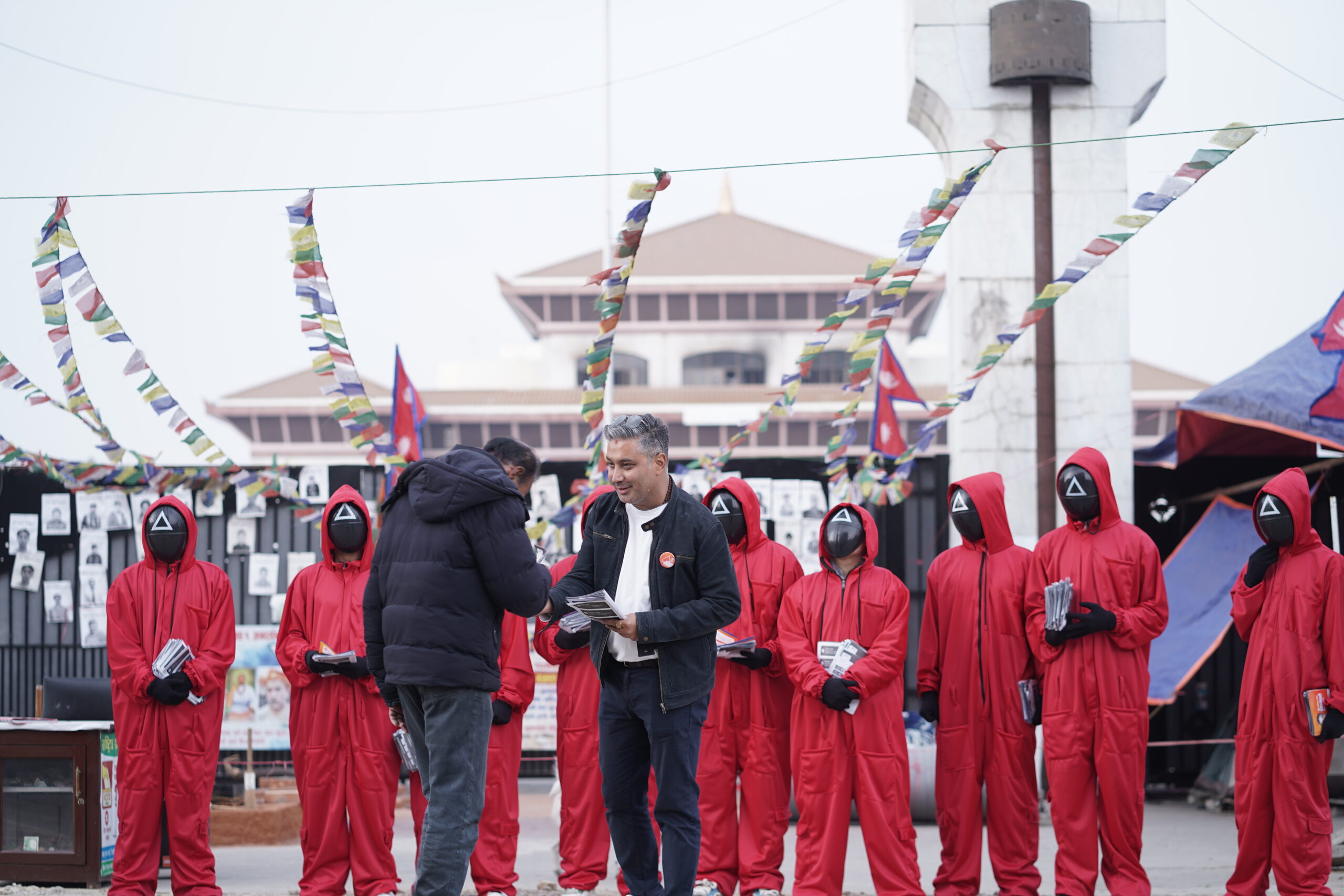
One of the more unusual aspects of his campaign involved a promotional stunt inspired by the popular streaming series Squid Game. Basnyat arranged for a group of people dressed in costumes resembling characters from the show to walk through streets in Kathmandu as part of his campaign.
The costumes were designed with triangular symbols on the masks, coinciding with his election symbol, while participants moved through neighbourhoods or rode on a pickup truck as part of the campaign activity. The idea, Basnyat said, was intended to spark curiosity among voters and draw attention to his candidacy without resorting to traditional campaign methods.

The entire promotional exercise reportedly cost him around 18,000 Nepalese rupees. The masks were sourced from India for approximately ₹199 each, while the costumes were purchased for around 1,500 Nepalese rupees.
Basnyat said the concept emerged during door-to-door outreach when he noticed that residents often reacted with fatigue toward repeated campaign visits from candidates. The unusual visual campaign, he believed, would prompt voters to seek information about his candidacy instead.
Whether the strategy will translate into electoral success remains uncertain. With an estimated six thousand votes often sufficient to win the constituency, the results of the election will ultimately determine whether Basnyat’s experiment with a low-cost campaign can secure the mandate he hopes for.
For now, the outcome of his unconventional approach lies sealed in ballot boxes as Nepal awaits the final vote count.