New Delhi, April 2: NASA has permitted astronauts on the Artemis II mission to carry personal iPhones into deep space for the first time, marking a significant change in how crew equipment is managed for human spaceflight beyond Earth’s orbit.
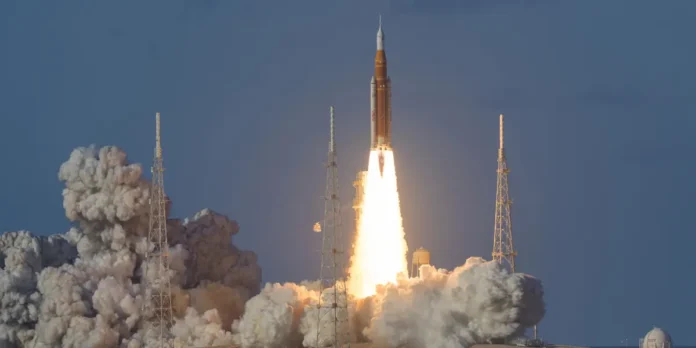
The four-member crew, Reid Wiseman, Victor Glover, Christina Koch, and Jeremy Hansen, launched aboard the Orion spacecraft mounted on the Space Launch System rocket from Kennedy Space Center in Florida on Wednesday. The mission is a 10-day journey that will take the astronauts around the Moon and back, making it the first crewed flight to the lunar vicinity in over five decades.
The decision to allow personal smartphones was announced earlier this year by NASA Administrator Jared Isaacman as part of a broader effort to modernise onboard equipment and improve mission documentation. The move enables astronauts to record moments during the mission without depending solely on standard-issue government cameras.

According to NASA, the devices will function primarily as cameras during the deep space phase. All smartphones will remain in aeroplane mode to prevent any interference with spacecraft systems. The agency clarified that the phones are not intended for communication during most of the mission.
However, when the spacecraft passes near the International Space Station, astronauts will be able to connect to onboard Wi-Fi systems. This will allow them to transmit photos and emails, though voice communication through the devices will not be possible.
NASA said the inclusion of modern consumer technology is part of its broader approach to streamline mission operations and enhance crew experience. Officials indicated that testing and qualifying such hardware for space use within shorter timelines could benefit future lunar and orbital missions.

The Artemis II mission also aims to capture detailed visual data during its lunar flyby. The crew is expected to record live imagery of the Moon’s surface and observe features not previously seen directly by humans. The mission will also provide a vantage point to witness a partial solar eclipse from deep space.
This mission represents a key step in NASA’s Artemis programme, which focuses on returning humans to the Moon and establishing a long-term presence for future exploration. The integration of personal devices reflects evolving operational practices as the agency prepares for more complex missions beyond Earth orbit.
NASA officials emphasised that while the addition of smartphones introduces convenience, all safety protocols and system safeguards remain fully in place to ensure mission integrity.