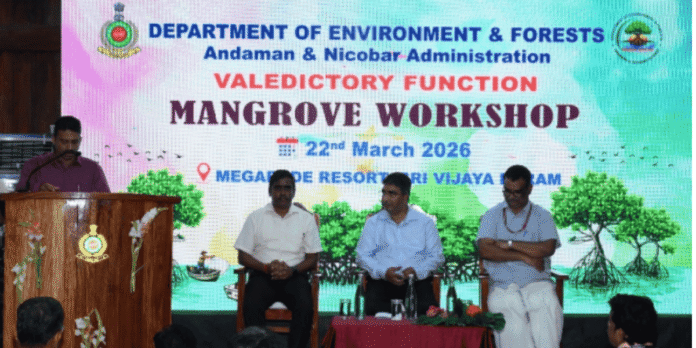
A mangrove-focused workshop bringing together scientists, researchers and students concluded at Megapode Resort in Haddo, Sri Vijaya Puram, with participants emphasising research, conservation and community-linked approaches to coastal ecosystem management in the Andaman and Nicobar Islands.
The valedictory session was attended by Sanjay Kumar Sinha, Principal Chief Conservator of Forests-cum-Chief Wildlife Warden, who addressed participants on the ecological importance of mangroves and the need for sustained academic and field-based engagement. The event also saw the presence of B. Nagarajan, Scientist-G and Group Coordinator (Research) at the Institute of Forest Genetics and Tree Breeding, Coimbatore, along with senior forest officials, scientists, scholars and students.
The programme opened with a welcome address and report presentation by Joju P. Alappatt, Deputy Conservator of Forests (Working Plan), outlining the scope and proceedings of the workshop. Over the course of the sessions, participants examined multiple dimensions of mangrove ecosystems, including their role in coastal protection, biodiversity conservation and climate resilience.

In his address, Sinha highlighted the ecological value of mangrove systems, noting their role in supporting diverse life forms and sustaining livelihoods in coastal regions. He encouraged students and research scholars to engage more deeply with mangrove ecosystems and called for continued academic initiatives on similar themes.
Earlier, S. Dinesh Kannan, Chief Conservator of Forests (Research & Working Plan and Wildlife), urged the research community to explore emerging areas in coastal and marine ecosystems. He pointed to opportunities under the National Coastal Mission, a Government of India initiative, as a platform for expanding research and field engagement.
The workshop featured thematic sessions led by subject experts and scientists from both mainland India and the islands. Discussions were structured around five key areas: the role of mangroves in coastal protection and climate change mitigation; biodiversity and associated marine ecosystems; eco-tourism potential in mangrove regions; restoration practices and techniques; and community participation linked to livelihood opportunities.
Experts who led sessions included Sanjay Srivastava, former Principal Chief Conservator of Forests, Tamil Nadu; B. Nagarajan of IFGTB; Sivaperuman, Scientist and Deputy Director at the Zoological Survey of India, Sri Vijaya Puram; Nehru Prabhakaran from the Wildlife Institute of India, Dehradun; and Ramanathan, Director at the Centre of Advanced Study in Marine Biology, Annamalai University, Tamil Nadu.

A total of 17 research papers were presented during the workshop by faculty members, research scholars, non-governmental organisations and teachers from both the islands and the mainland. Departments of the Andaman and Nicobar Administration also contributed presentations, reflecting institutional engagement with coastal ecosystem management.
The event recorded participation from 75 attendees, including students, teachers and researchers, indicating academic interest in mangrove-related studies. Organisers noted that such platforms are critical for knowledge exchange and capacity building in regions where coastal ecosystems play a central role in environmental stability and livelihoods.
During the valedictory session, participation certificates were distributed and awards for best paper presentations were presented. The event concluded with a vote of thanks delivered by S. Simmi, Assistant Conservator of Forests (Working Plan).