A young resident of Little Andaman Island has emerged as an example of rural entrepreneurship after successfully establishing a poultry farming venture with support from government departments and local institutions.
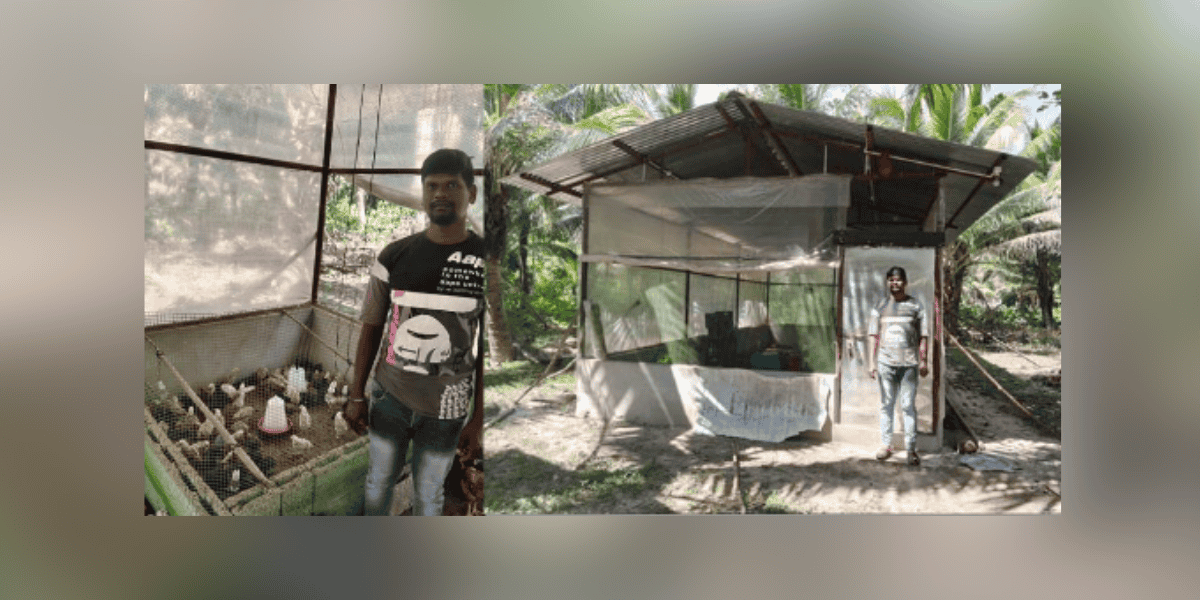
Krishna Ram, a resident of Nanjappa Nagar in Little Andaman, turned to poultry farming after struggling to find regular employment. His initiative, supported by the Department of Animal Husbandry and Veterinary Services and the Community Level Federation (CLF) Hutbay, has now developed into a promising livelihood activity.
According to officials, the journey began when Krishna Ram, unable to secure stable work, started exploring alternative livelihood options. While searching for ideas online, he came across videos related to poultry farming on YouTube, which inspired him to attempt the activity despite having no prior experience in the field.
Encouraged by the possibility of starting a small farm, he decided to experiment with poultry farming using the knowledge he gained from online resources. His efforts soon received institutional support when he was provided with Vanaraja chicks through CLF Hutbay.

Authorities said a total of 180 Vanaraja chicks were supplied to him under the initiative, along with timely access to medicines provided by the Department of Animal Husbandry and Veterinary Services. The support enabled him to establish a poultry unit with relatively limited initial investment.
Vanaraja is a dual-purpose poultry breed often promoted in rural areas because of its adaptability and ability to produce both meat and eggs under backyard farming conditions. The breed is considered suitable for small-scale farmers due to its resilience and relatively low maintenance requirements.
With regular care and proper feeding, the chicks gradually developed into healthy birds. Officials reported that as of January 15, 2026, 171 birds remained in good health and had reached a weight of approximately 1.2 to 1.5 kilograms each.
The farmer is planning to sell the birds in the local market within a short period, with an expected wholesale price of around ₹300 per kilogram. Based on the projected sale value, he anticipates earning a significant return from the current batch.
According to estimates shared by the department, Krishna Ram invested approximately ₹16,000 towards feed and basic infrastructure required for the poultry unit. With the expected sales, he is likely to earn a profit of around ₹62,000 from the batch.
Encouraged by the results of his first cycle of poultry farming, he has decided to continue and expand the activity as a full-time occupation. Officials said the outcome demonstrates the potential of small-scale poultry farming as a viable livelihood option in rural and island communities.

The initiative also highlights the role of institutional support in helping unemployed youth explore self-employment opportunities. Through the supply of quality chicks, access to veterinary care and technical guidance, the Department of Animal Husbandry and Veterinary Services and CLF Hutbay have been working to encourage rural livelihoods in the region.
Authorities indicated that such programmes are designed to help individuals adopt income-generating activities that can be managed within the local environment. Backyard poultry farming, in particular, has been promoted in several island communities due to its relatively low investment requirements and the steady market demand for poultry products.
Officials said the example from Nanjappa Nagar reflects how targeted assistance combined with individual initiative can create sustainable livelihood opportunities. By supporting small-scale ventures, the department aims to encourage more rural youth to consider entrepreneurship as an alternative to wage employment.
With the success of the poultry unit drawing attention in the local community, authorities believe the example could motivate others in the region to explore similar livelihood options, especially in areas where access to traditional employment opportunities may be limited.