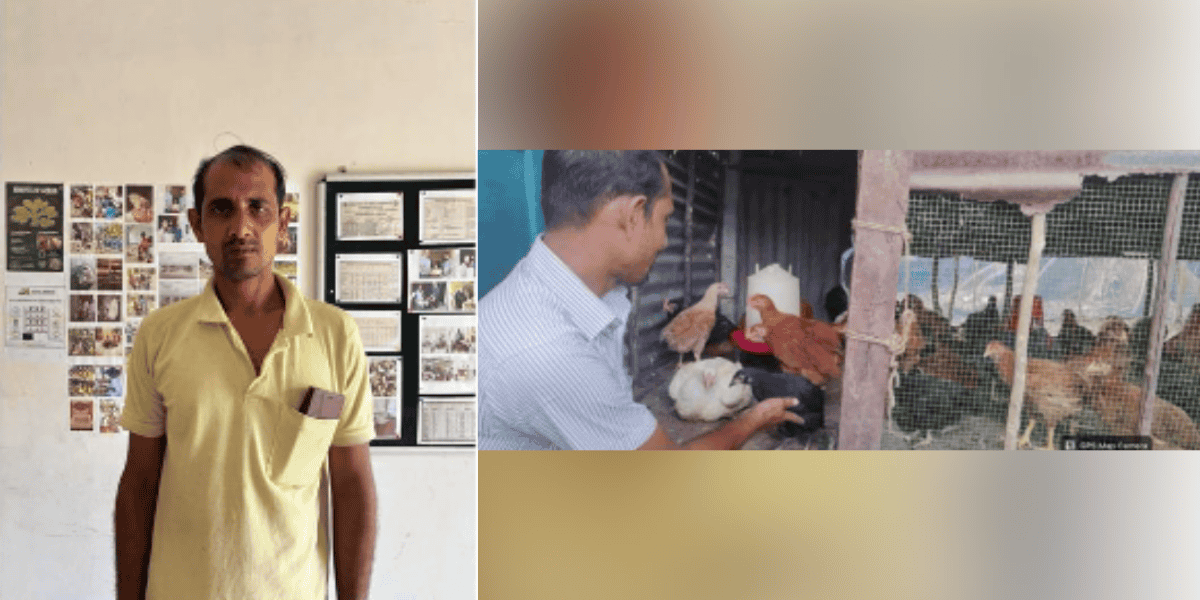
A resident of Khichad Nallah in Little Andaman Island has transitioned from working as a private daily wage labourer to running a growing poultry farm, reflecting the impact of training and technical support provided by the Department of Animal Husbandry and Veterinary Services.
Subash Mondal began exploring poultry farming as a livelihood option amid the lack of steady employment opportunities in the area. With no prior experience in the field, he turned to the department for guidance and gradually built his knowledge of poultry rearing through training programmes and practical support.
According to information released by the department, Mondal received day-old chicks at government rates along with free medicines whenever required. Officials said that these inputs, combined with technical guidance from veterinary staff, enabled him to begin poultry farming on a small scale.

Through the department’s training initiatives, Mondal was introduced to scientific poultry management practices and modern rearing techniques. These included feeding practices, disease management, housing requirements and general farm maintenance aimed at improving productivity and ensuring healthier flocks.
The initial phase of the venture involved a trial batch of birds. After completing the rearing cycle, Mondal successfully sold the birds and earned a profit, marking a turning point in his efforts to establish a sustainable livelihood through poultry farming.
As of January 15, 2026, the farm was maintaining more than 300 chicks of Nicobari and Vanaraja breeds. Both breeds are commonly promoted in rural poultry initiatives due to their adaptability and suitability for backyard and semi-intensive farming systems in island conditions.
Encouraged by the outcome of the first batch, Mondal has begun preparing the next batch of birds for sale. The expansion reflects a gradual scaling of the enterprise, supported by continued guidance from the department.
Officials said the case illustrates how targeted training and support programmes can help residents adopt alternative livelihoods in areas where conventional employment opportunities remain limited. Poultry farming has been promoted as a viable income-generating activity in rural parts of the islands because of relatively low investment requirements and steady market demand.
The Department of Animal Husbandry and Veterinary Services has been conducting training sessions for farmers and youth across the islands to build capacity in livestock and poultry farming. These programmes focus on improving knowledge of scientific practices, disease prevention and efficient farm management.
The department also provides inputs such as chicks, veterinary care and medicines to farmers who participate in the programmes, enabling them to start or expand their ventures with technical backing.

Officials noted that such initiatives are aimed at strengthening rural livelihoods while promoting self-employment among unemployed youth and daily wage earners. By adopting poultry farming, farmers can generate regular income while also contributing to local food supply.
The department expressed hope that the progress achieved in this case would encourage more residents to consider poultry farming as a livelihood option. With appropriate training, technical guidance and support from government programmes, officials believe that similar ventures can be replicated in other parts of the islands.
The initiative forms part of broader efforts to promote livestock-based livelihoods in remote island communities where agriculture and allied activities remain an important source of income.