The Andaman and Nicobar Islands’ long-term development strategy, spanning infrastructure, connectivity, maritime capacity and tourism, was outlined in detail at a public address in New Delhi on February 27, placing the island territory within the broader national vision of Viksit Bharat. The address provided a consolidated overview of projects already underway and those in the pipeline, underscoring the strategic and economic importance of the islands.
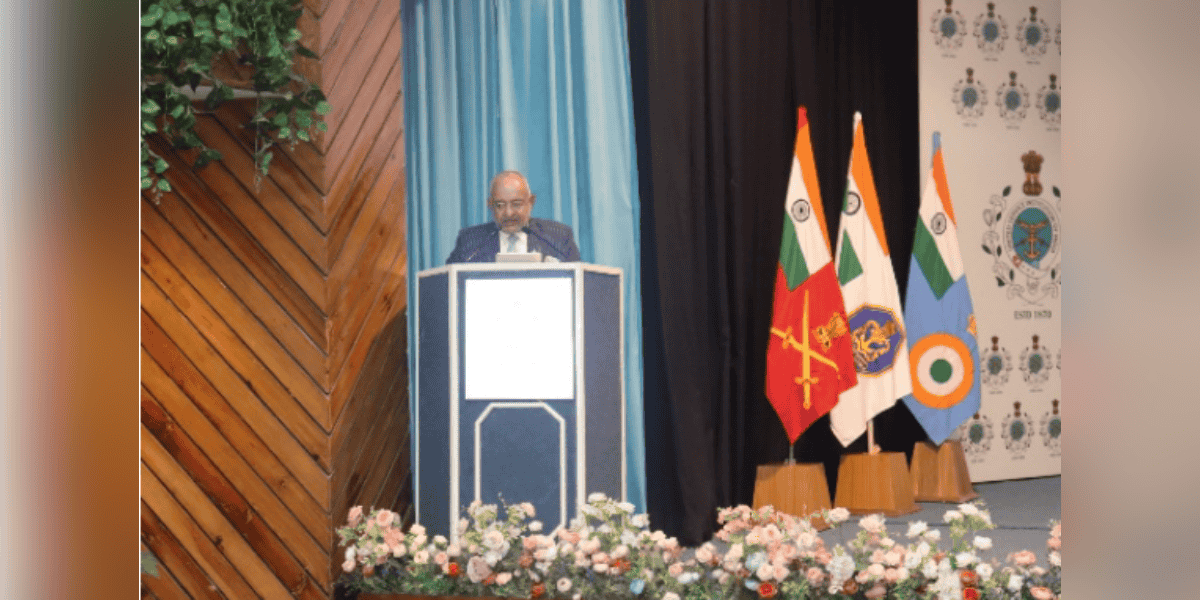
Speaking at the United Service Institution of India, the Lieutenant Governor of Andaman and Nicobar Islands Admiral ( retd) DK Joshi highlighted the role of the Islands Development Agency in driving large-scale initiatives designed to strengthen surface connectivity, aviation infrastructure, digital networks and maritime capabilities. The event was attended by members of think tanks, academic institutions, media and policy researchers.
Surface connectivity was presented as a key enabler of development, with ongoing projects aimed at reducing travel time and improving mobility between islands. Expansion and double-laning of National Highway-4, completion of the Azad Hind Fauj Setu and construction of the Middle Strait Bridge were cited as projects expected to cut travel duration by more than half once operational. These works are seen as critical for economic integration, emergency response and public service delivery across the geographically dispersed territory.

Digital infrastructure development was highlighted as another priority area. The operationalisation of the Chennai–Andaman and Nicobar Islands submarine cable project has significantly improved bandwidth and reliability, while a proposed optical fibre redundancy link between Digha and Diglipur is intended to safeguard connectivity against disruptions. Reliable digital infrastructure was described as essential for governance, education, healthcare and business services in the islands.
In the aviation sector, attention was drawn to the commissioning of the new integrated terminal at Veer Savarkar International Airport and the commencement of international flight connectivity, marked by the maiden landing of an AirAsia flight from Kuala Lumpur. To attract additional international and domestic carriers, incentives such as waivers on aviation turbine fuel, landing charges and user development fees have been extended. Plans for greenfield airports at Sri Vijaya Puram and Great Nicobar were also outlined, along with runway expansion at INS Baaz in Campbell Bay and INS Kohassa in Shibpur, with an emphasis on dual-use infrastructure.
Under regional connectivity initiatives, infrastructure under the UDAN scheme has been finalised and is expected to be handed over to airline operators, while helicopter services are being modernised to improve inter-island access. Proposals to revive seaplane operations were also mentioned as part of efforts to enhance connectivity to remote and tourism-focused locations.
Maritime infrastructure formed a central pillar of the address. Galathea Bay’s notification as India’s 13th major port was highlighted as a strategic milestone, with development planned under a public-private partnership model. The proposed International Container Transshipment Terminal at Great Nicobar is envisaged as a major hub in the Indo-Pacific region, with Phase I operations targeted within three years and an ultimate handling capacity of 20.4 million TEUs. Projects related to Great Nicobar, valued at over ₹82,000 crore, including port infrastructure, power generation and a proposed township, were described as transformative in terms of trade, connectivity and national security.
The address also highlighted the Port Meadows project for ship-to-ship transshipment, for which an agreement has been signed with Matsya Shipping. A pre-feasibility study conducted by IIT Madras for a deep-water port at Atlanta Bay in Diglipur was cited as part of plans to expand ship repair, shipbuilding and yacht marina facilities. Efforts to unlock hydrocarbon exploration potential in the Andaman Basin were also referenced, following the release of significant portions of previously restricted areas.

Energy security featured prominently in the development narrative. The administration is working towards achieving complete de-dieselisation through renewable energy initiatives, including ground-mounted and rooftop solar projects for homes and government buildings. Plans for a 50 MW LNG-based power plant through NTPC Limited, studies on small modular nuclear reactors and a proposed HVDC link from mainland India were outlined as measures to meet projected peak demand while reducing reliance on diesel generators.
Tourism development was positioned as both an economic driver and a strategic soft-power asset. The auctioning of islands and tourism assets such as Long Island, Aves Island, Shaheed Dweep and the Megapode Resort at significant premiums was cited as evidence of investor interest. Plans are in place to develop additional islands and the Rangachang project through transaction advisors. Radhanagar Beach at Swaraj Dweep continues to hold Blue Flag certification, while multiple other beaches are being upgraded to meet international standards. Growth in cruise tourism, including international cruise halts, was also highlighted.
The address concluded by linking island development with national priorities of self-reliance, innovation and economic expansion, projecting the Andaman and Nicobar Islands as a strategic contributor to India’s long-term growth and maritime presence.