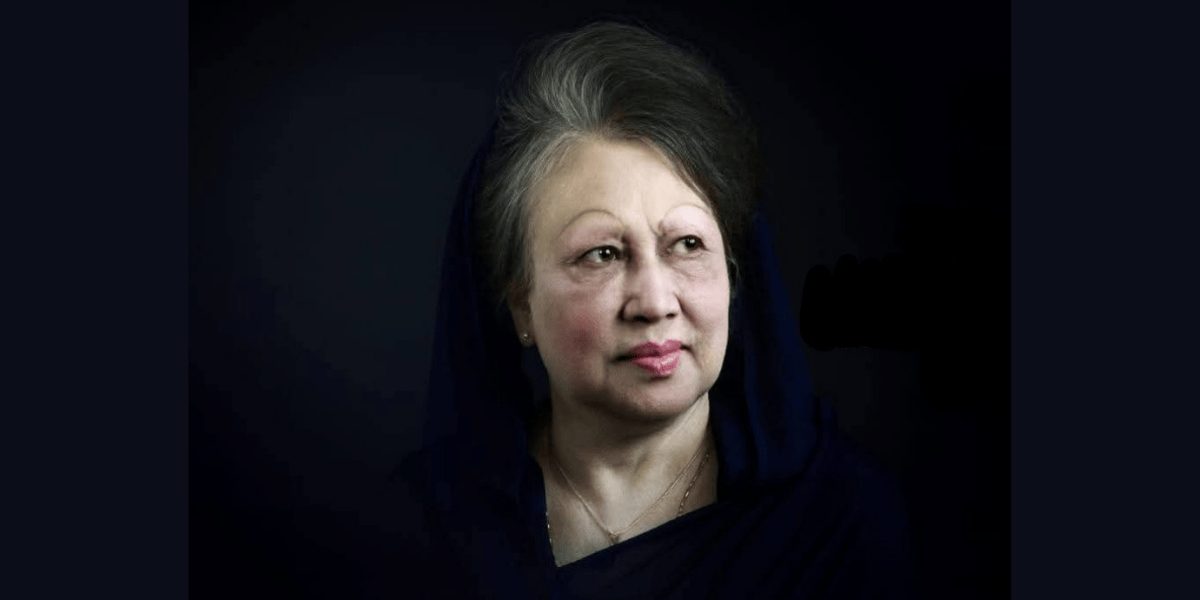
Khaleda Zia, Bangladesh’s first woman Prime Minister and a central figure in the country’s politics for more than four decades, died early Tuesday morning after a prolonged illness. She was 80.
A three-time Prime Minister and long-serving chairperson of the Bangladesh Nationalist Party (BNP), Zia’s political career shaped Bangladesh’s post-independence trajectory and defined its often turbulent domestic and foreign policy debates. Her death marks the end of an era in Bangladeshi politics dominated for decades by two leaders, Khaleda Zia and Awami League chief Sheikh Hasina.
Born in 1945 in Jalpaiguri, then part of undivided India, Khaleda Zia moved with her family to East Pakistan following Partition. She entered public life after marrying Ziaur Rahman in 1960, who later emerged as a key figure in the 1971 Bangladesh Liberation War and went on to become President in 1977. He founded the BNP in 1978.

Following Ziaur Rahman’s assassination in 1981, the BNP faced a leadership vacuum. Party leaders urged Khaleda Zia to step forward, and she was appointed vice-president in January 1984 before becoming chairperson later that year. She retained the post through successive party councils in 1993, 2009 and 2016, remaining at the helm of the BNP for nearly 41 years.
Zia was sworn in as Bangladesh’s first female Prime Minister after the BNP’s victory in the 1991 parliamentary elections. She served a second term following the 1996 elections and returned to office for a third term in October 2001.
Her years in power coincided with strained India–Bangladesh relations. Zia adopted a cautious and often adversarial approach toward New Delhi, opposing overland transit and connectivity arrangements and rejecting India’s requests for access to its northeastern states through Bangladeshi territory. She also opposed the renewal of the 1972 Indo-Bangladesh Friendship Treaty, arguing it restricted Bangladesh’s sovereignty.
Disputes over the Farakka Barrage, defence cooperation with China, and allegations by India that militant groups operated from Bangladeshi soil further complicated bilateral ties during her tenure. Relations began to improve only after she left office.

After losing power, Zia continued to play a prominent role as Leader of the Opposition, positioning herself as a defender of democratic rights. She faced legal challenges in later years and was sentenced to prison in 2018 in a corruption case. Her sentence was suspended in 2020 amid the Covid-19 pandemic, and she was fully released in August 2024 through a presidential order.
Zia returned to Dhaka in May after receiving medical treatment in London. She was hospitalised again in November with heart and lung complications and remained under medical supervision until her death.
She is survived by her elder son and BNP acting chairman Tarique Rahman, his wife Zubaida Rahman, and their daughter Zaima Rahman. Her younger son, Arafat Rahman Koko, died earlier.