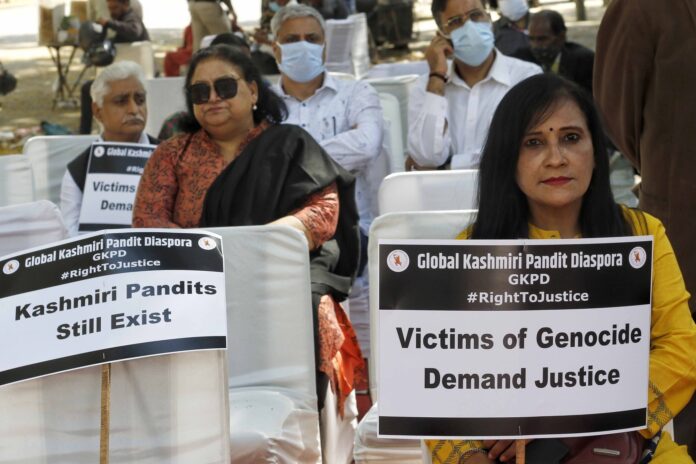
Kashmiri Hindu advocacy groups in the United States on Monday renewed their call for justice, restitution and secure rehabilitation of the displaced community, marking January 19 as Exodus Day and reiterating long-standing demands linked to the mass displacement of Kashmiri Hindus from the Valley in the early 1990s.
In a joint statement, the Kashmir Hindu Foundation and Panun Kashmir described January 19 as a reminder of what they termed the systematic displacement of Kashmiri Hindus, asserting that the events surrounding the exodus represented a sustained and deliberate process rather than an isolated episode. The groups said the day symbolised the loss of homes, livelihoods and civilisational roots for a community that had lived in Kashmir for centuries.
The organisations rejected what they described as symbolic gestures and selective remembrance, arguing that such approaches failed to address the deeper political, security and cultural dimensions of the displacement. They also criticised narratives that focus on tourism and economic revival without addressing the unresolved grievances of the displaced population.
Speaking at the event, Sunanda Vashisht, writer and political commentator and Chairperson of the Jonaraja Institute of Genocide and Atrocities Studies, said the displacement of Kashmiri Hindus should not be viewed as a single historical incident. She described genocide as a process aimed at erasing or weakening identity-based groups perceived as threats by dominant forces, and said the Kashmiri Hindu experience needed to be understood within that broader framework.
Panun Kashmir Convener Agnishekhar said that the return and rehabilitation of displaced Kashmiri Hindus would only be possible through the adoption of the Margdarshan Resolution by the Government of India. He argued that alternative approaches did not adequately address the political status, security guarantees and civilisational continuity sought by the community. According to him, any rehabilitation plan that ignored these dimensions risked repeating past failures.
The issue of cultural identity also featured prominently in the discussions. Nitin Dhar, representing the Panun Kashmir Youth Wing, rejected the popular narrative of “Kashmiriyat,” stating that Kashmir historically followed what he described as “Kashmir Deshachar,” a distinct civilisational and cultural ethos. He argued that later political developments and violence had destroyed this historical framework and that revised narratives could not substitute historical records.
Property rights emerged as a key demand during the observance. Kashmir Hindu Foundation founder Deepak Ganju called for all movable and immovable properties sold by displaced Kashmiri Pandits after 1989 to be officially declared “distress sales.” He said such transactions should be rendered null and void, with ownership restored to the original holders in accordance with land records. The demand reflects long-standing concerns within the community about economic dispossession following displacement.
KHF President Anit Monga also sought a blanket ban on the acquisition or encroachment of abandoned properties belonging to displaced Kashmiri Hindus. He said safeguarding these assets was essential to any credible rehabilitation framework and warned that continued encroachment further weakened the prospects of return.
The advocacy groups reiterated that their demands were rooted in constitutional guarantees and moral responsibility rather than political expediency. They urged Indian authorities to formally acknowledge the scale and nature of the displacement and to initiate measures that ensured justice and accountability.
The groups also appealed to civil society and the international community to recognise the issue as a matter of human rights and historical accountability. They said meaningful reconciliation and sustainable peace in Kashmir required addressing the grievances of displaced communities alongside broader political and security concerns.
As India continues to debate pathways for stability and development in Jammu and Kashmir, the statements issued on Exodus Day underscored that, for the Kashmiri Hindu diaspora, questions of justice, restitution and dignified return remain unresolved more than three decades after the exodus.



