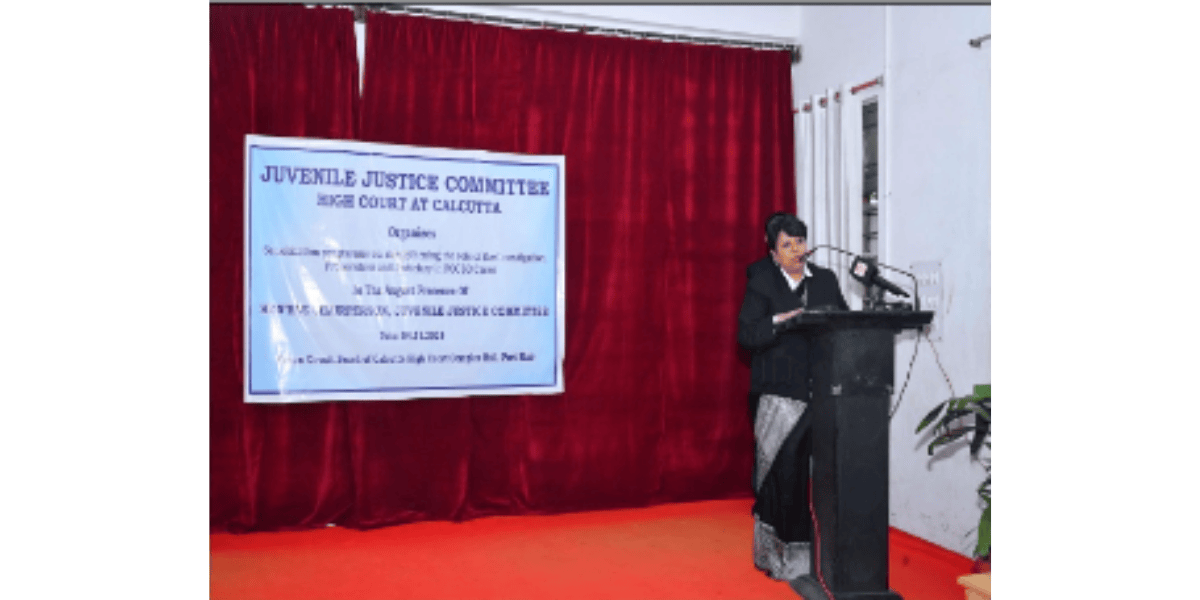
The Juvenile Justice Committee (JJC) of the High Court at Calcutta held a one-day programme in Sri Vijaya Puram on November 4 to discuss strategies for strengthening the handling of Protection of Children from Sexual Offences (POCSO) cases across the Andaman and Nicobar Islands. The session, held in the Court Hall of the Circuit Bench of the Calcutta High Court, brought together members of the judiciary, prosecution, administration, and law enforcement agencies to deliberate on improving coordination and accountability in child protection matters.
The programme was chaired by Justice Shampa Sarkar, Judge of the Calcutta High Court and Chairperson of the Juvenile Justice Committee, with Justice Ananya Bandyopadhyay also gracing the occasion. Their participation underlined the judiciary’s commitment to addressing systemic challenges that hinder the effective implementation of the POCSO Act, 2012.
In her address, Justice Sarkar highlighted that the goal of the session was to identify and bridge persistent gaps in investigation, prosecution, and judicial processes concerning offences against children. The discussion emphasized the collective responsibility of all stakeholders, from investigators and prosecutors to social welfare agencies and healthcare professionals, in ensuring justice for victims while maintaining child-sensitive procedures.
The event featured a series of expert presentations and panel discussions that explored practical solutions for expediting case disposal and strengthening evidence collection. Speakers included Neyaz Alam, Special Judge (POCSO); Niharikha Bhatt, IPS, Superintendent of Police; Ravinder Kumar, Director of Social Welfare; Deep Chaim Kabir, Senior Advocate; D. Ilango, Advocate; and Dr. M. Ashwini Kumar, Assistant Professor, Department of Forensic Medicine, ANIIMS. Each shared insights on the operational and ethical dimensions of handling POCSO cases, including the importance of trauma-informed investigation and inter-agency coordination.
A panel discussion, moderated by Senior Advocate Deep Chaim Kabir, featured Chief Judicial Magistrate Samrat Roy, Judge (JJB) Jayanto Mukherjee, Special Public Prosecutors (POCSO) A. S. Zinu and Tasneem, and Dr. Kushal Baidya, Assistant Professor (Psychiatry) at ANIIMS. The interactive session focused on the need for consistent training, improved documentation, and mental health support for both victims and professionals involved in such cases.

Participants discussed procedural challenges like delays in medical examination reports, inconsistent witness handling, and the need for better evidence preservation. The speakers also stressed the importance of multi-disciplinary collaboration, particularly between police investigators, doctors, psychologists, and judicial officers. Such cooperation, they said, was crucial to maintaining the integrity of child protection frameworks.
The deliberations underscored the importance of ensuring that POCSO cases are handled with sensitivity, speed, and precision. Judicial officers emphasized the need to balance the rights of the accused with the protection of minors, ensuring that child victims are neither retraumatized nor silenced during the judicial process.
Registrar Rashid Alam of the Circuit Bench hosted the event, delivering the welcome address and concluding with a vote of thanks. The discussions reflected the High Court’s proactive stance in fostering inter-departmental understanding and aligning field-level practices with the broader vision of child protection laws in India.
The Juvenile Justice Committee’s programme forms part of a sustained national initiative to strengthen child protection systems and sensitize judicial and enforcement agencies about the psychosocial needs of child survivors. Officials noted that such exercises are critical for building institutional empathy and operational capacity, particularly in geographically remote regions like the Andaman and Nicobar Islands, where logistical constraints can often delay justice delivery.
By emphasizing training, collaboration, and awareness, the High Court’s initiative seeks to build a robust ecosystem that upholds the spirit of the POCSO Act, ensuring that justice is not just delivered, but done so with compassion and care.
The event concluded with a reaffirmation of the judiciary’s commitment to zero tolerance for child abuse and its determination to ensure that every child survivor receives timely, fair, and dignified treatment under the law.