By R.P. Sharma & M Shradha
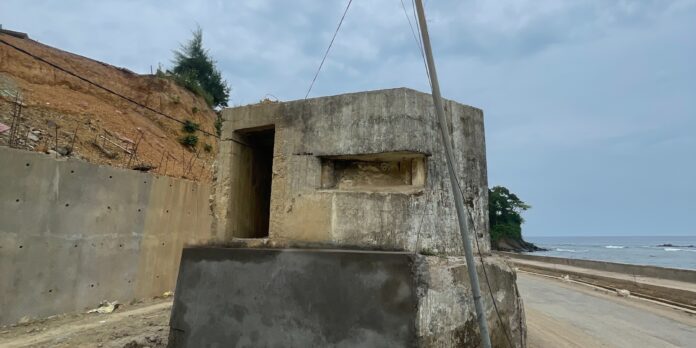
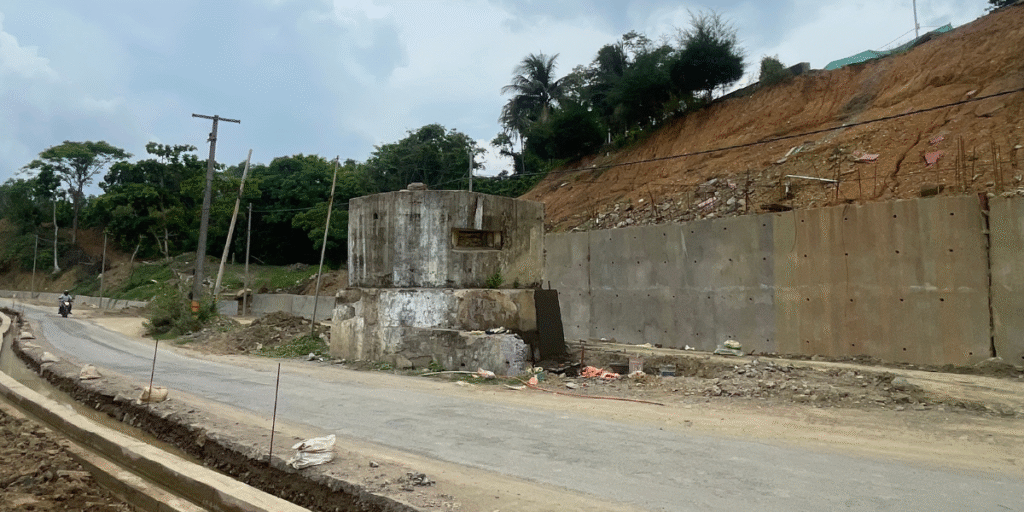
A decaying, World War II–era Japanese bunker en route to Corbyn’s Cove Beach seems to be fighting a lone battle for survival. The years and decades of rough and tumble by Mother Nature have taken a toll on numerous fellow bunkers, but this one, still standing tall in the middle of the road being reconstructed, appears to be insisting on telling its own story to posterity.
Built during Japan’s occupation of the Andaman Islands between 1942 and 1945, the structure once served as a strategic military lookout and now stands critically endangered, with no preservation measures in place.
Once located on the seaside of the then-narrow road, overlooking the endless waters of the Bay of Bengal for any suspicious activity of the colonial British armada’s invading vessels, the bunker now faces the mortal fear of being decimated on the altar of development.
The ongoing hectic road widening work being undertaken by the Andaman Public Works Department (APWD), once completed, will offer visitors to Corbyn’s beach the ease of commuting, besides enjoying the breathtaking view of the azure sea.
Decades of neglect, combined with the harsh coastal climate, have weakened the structure. The recent round of road work near the site inflicted additional structural damage. Most other similar bunkers across the islands have either collapsed, been overtaken by vegetation, or been lost to development.
Residents and heritage-conscious locals are alarmed by the bunker’s deteriorating condition. “I would request the authorities to preserve this bunker built by the Japanese before it’s too late. It is also a part of our islands’ dark history and struggles,” said Sharada Ram, a senior citizen from Sri Vijaya Puram.
Despite repeated concerns, efforts by The Wave Andaman to reach the responsible authorities have gone unanswered, adding to the apprehensions of permanent loss.
In 1942, during World War II, the Japanese Imperial Army invaded the British-ruled Andaman Islands, drawn by their strategic Indian Ocean location. Over the next three years, they militarised the region, constructing nearly 300 concrete bunkers across the islands, particularly in Sri Vijaya Puram (formerly Port Blair). These structures stored weapons, served as command posts, and monitored coastal movement. The occupation ended in 1945 with the return of Allied control.
The Corbyn’s Cove bunker is one of the few surviving remnants of the brutal Japanese regime, during which nearly 10% of Sri Vijaya Puram’s population died due to forced labour, starvation, torture, and mass deportations. These bunkers stand not just as military relics but as mute witnesses to a traumatic period in local history. Their disintegration marks a growing cultural and historical amnesia.