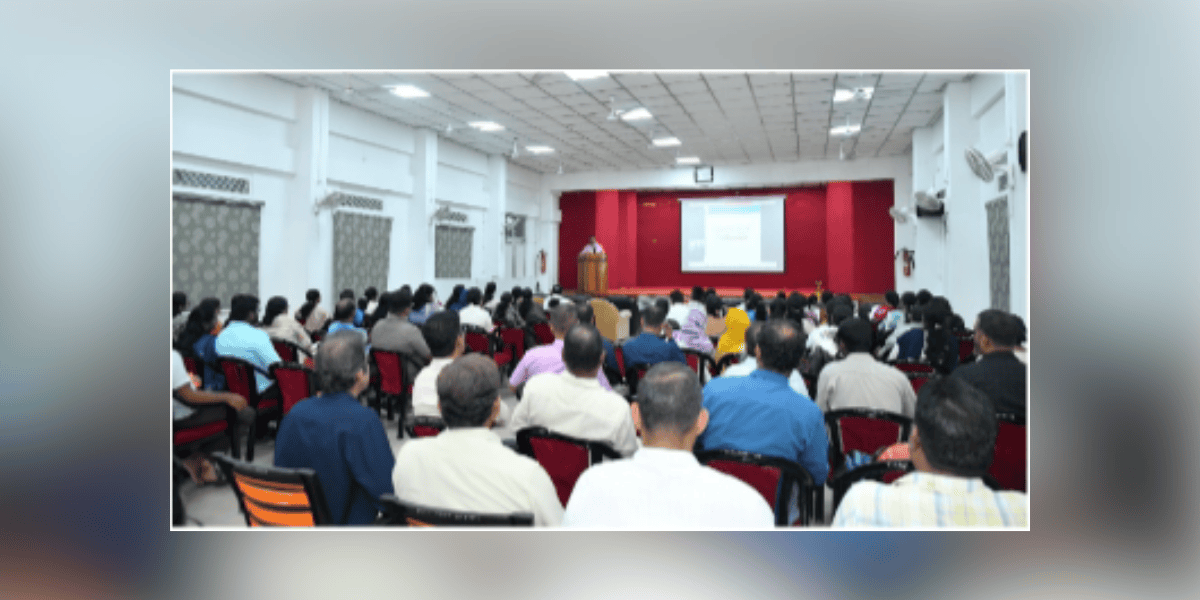
A five-day capacity-building initiative focusing on pay rules, service benefits and transparency procedures is underway in Sri Vijaya Puram, bringing together staff from the amalgamated clerical cadre as part of the Administration’s ongoing effort to strengthen institutional efficiency. The programme, organised by the AR and Training Wing of the Andaman and Nicobar Administration in collaboration with the Institute of Secretariat Training and Management, has drawn participation from clerical personnel across departments and is designed to improve their working knowledge of pay fixation norms, MACP provisions and procedures under the Right to Information framework.
The training began earlier this week at the auditorium of the Teachers’ Training College in Sri Vijaya Puram and will run for five days. The sessions are being conducted by two experts deputed by ISTM, New Delhi, a serving deputy director and a retired deputy director, who are leading modules on the principles and practical applications of pay regulation and career progression policies. For many participants, the programme offers an opportunity to clarify procedural issues that frequently arise in day-to-day administrative work, particularly in matters involving service conditions and financial entitlements.

The inaugural session included an address from senior officials who underscored the role of continuous skill enhancement in ensuring seamless public service delivery. They noted that clerical staff form a key operational foundation of the Administration, handling records, correspondence, financial papers and citizen-facing documentation that must comply with both national and local guidelines. The programme aims to equip them with the latest interpretations and instructions issued by central agencies, while also improving their responsiveness to internal and public queries.
The curriculum covers three broad areas. The first centres on pay fixation, explaining how pay is determined under different circumstances such as promotions, rule amendments or transfers between posts. Participants are being taken through case-based exercises illustrating how pay calculations are applied in accordance with central civil services rules. The second component examines the Modified Assured Career Progression scheme, which governs periodic financial upgradation for employees who have completed stipulated years of service without regular promotions. Trainers are focusing on common errors, documentation standards and verification processes that departments must follow to ensure accuracy.
The third major segment deals with implementation of the Right to Information Act. While the islands have reported steady levels of RTI usage, officials believe that updated training is essential to maintain compliance, particularly regarding timelines, exemptions, disclosure procedures and file management. Participants are being briefed on their responsibilities as record keepers and on the importance of maintaining transparent, traceable documentation that can be produced when sought by applicants or higher authorities.

Feedback from the initial sessions suggests strong engagement, with clerical staff raising queries related to real-world administrative scenarios they routinely encounter. Trainers have been emphasising practical clarity over theoretical detail, responding to doubts on service books, pay anomalies, increment dates and maintenance of records under RTI norms. The focus on solving recurring issues is expected to help departments reduce processing delays and improve the quality of official responses.
The Administration has indicated that such capacity-building drives will continue in phases, targeting different cadres as part of long-term reforms aimed at modernising public administration. With departments increasingly required to handle digital records, manage citizen interface mechanisms and respond to audits or transparency requirements, officials consider regular skill-building essential for maintaining accuracy and accountability.
The ongoing programme is expected to conclude with a review session bringing together trainers and participants to consolidate learning outcomes. As the five-day initiative progresses, officials hope that the training will contribute to a more confident and better-informed clerical workforce capable of handling complex administrative responsibilities with greater consistency.