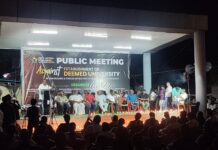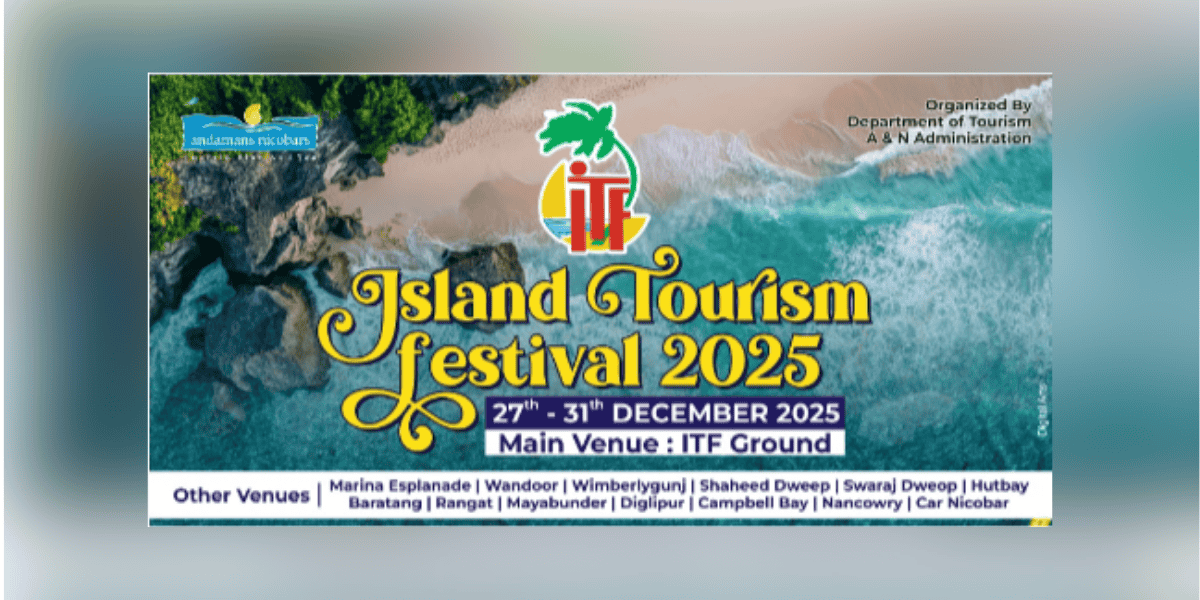
The five-day Island Tourism Festival 2025 commenced in Sri Vijaya Puram on December 27, bringing together cultural showcases, community programmes, exhibitions and public events as part of one of the Andaman and Nicobar Islands’ largest annual tourism initiatives. Organised by the Directorate of Information, Publicity and Tourism in association with the Directorate of Art and Culture and other departments of the Andaman and Nicobar Administration, the festival is being held at the ITF Ground on VIP Road and will continue until December 31.
The festival is designed to project the islands’ cultural diversity, artistic traditions and tourism potential, while also serving as a platform for government departments, self-help groups and local artisans to engage with the public. The opening ceremony featured a series of performances reflecting both island and mainland traditions, setting the tone for a programme that blends local heritage with national cultural expressions.
In a move to extend the reach of the festival beyond the capital, cultural programmes have been scheduled at multiple locations across South Andaman, North and Middle Andaman, and the Nicobar group of islands. Venues include Marina Esplanade, Wandoor, Wimberlygunj, Swaraj Dweep, Shaheed Dweep and Hut Bay in South Andaman; Baratang, Rangat, Mayabunder and Diglipur in North and Middle Andaman; and Car Nicobar and Campbell Bay in the Nicobar group. The decentralised format is aimed at ensuring wider public participation, particularly among residents of remote islands.

For the first time, cultural troupes from several states and Union Territories have been invited to participate alongside local artistes. Performances include classical, folk and tribal art forms presented in collaboration with national institutions such as the South Zone Cultural Centre and the Eastern Zonal Cultural Centre. Artistes from Chhattisgarh, Gujarat, Jammu and Kashmir, Uttar Pradesh and other regions are part of the programme, contributing to a diverse cultural lineup that highlights India’s regional traditions.
Alongside cultural events, several popular exhibitions and competitions have been incorporated into the festival schedule. These include flower, vegetable, fruit and pet shows, rangoli competitions and other public-interest activities organised by different departments. Government departments have also set up stalls to showcase developmental initiatives and public welfare programmes, while self-help groups are displaying and selling local handicrafts and homemade products, providing livelihood opportunities and market exposure.
A key social component of ITF 2025 is the Healthy Baby Contest, being organised by the Directorate of Health Services in association with the Union Territory Health Mission. Scheduled for December 30 at the ITF Ground, the contest is open to children from South Andaman in three age categories, ranging from six months to five years. The event aims to promote early childhood health awareness and immunisation while integrating public health messaging into a widely attended festival setting.

As in previous years, food courts offering a variety of cuisines, recreational games for children and a Hasya Kavi Sammelan organised by the Department of Official Language form part of the festival attractions. These elements are intended to make the festival a family-oriented public event while enhancing visitor experience during evening hours.
In view of the expected heavy footfall, the South Andaman District Administration has implemented traffic regulations around the ITF venue. The stretch from Hayat Singh Junction to RBV Junction has been notified as one-way during festival hours from 3 pm to 10 pm, with restrictions on vehicle movement towards VIP Road and diversion of heavy vehicles. Designated parking areas for two-wheelers and four-wheelers have been earmarked at multiple locations to manage congestion and facilitate smooth access to the venue.
Island Tourism Festival 2025 will be held daily from 5.30 pm to 10 pm until December 31. The administration has invited the general public to participate in the festival and experience the blend of culture, cuisine and community engagement that the event seeks to promote. The festival continues to serve as a key platform for celebrating island identity while reinforcing the Andaman and Nicobar Islands’ position on India’s tourism and cultural map.