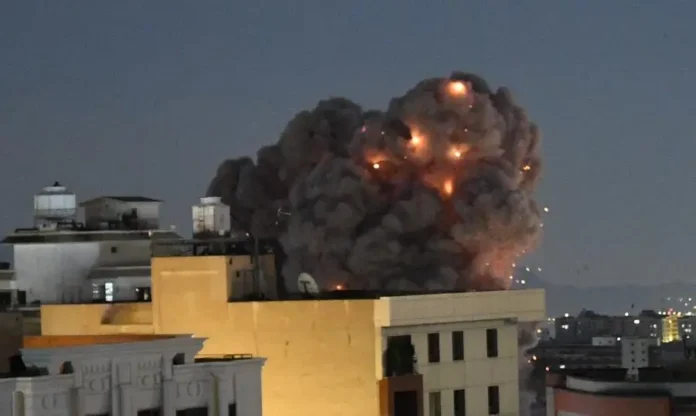
Tehran, April 4: Iran has rejected a United States proposal for a 48-hour ceasefire amid escalating hostilities, as military actions continued across the region, according to reports by Fars News Agency.
The ceasefire proposal was conveyed to Iran through a “friendly” country on Thursday, an informed source told the agency. The development comes at a time when United States has intensified diplomatic efforts to secure a temporary halt in fighting following recent attacks targeting its assets in the region.
The push for a ceasefire gained urgency after an Iranian strike reportedly hit a US military forces depot on Bubiyan Island. The escalation has raised concerns over the widening scope of the conflict and its potential impact on regional stability.

According to the report, the proposal followed an intensification of hostilities and what were described as “serious problems” faced by US forces, attributed to a miscalculation of Iran’s military capabilities. Iran’s response to the proposal was not formally communicated in writing. Instead, continued military operations were interpreted as a rejection of the offer.
Amid the ongoing conflict, Iran claimed multiple military successes. The Iranian army stated that its air defence systems had shot down a US A-10 “Warthog” attack aircraft over southern waters near the Strait of Hormuz, with the aircraft reportedly crashing into the Persian Gulf.
Separately, the Islamic Revolutionary Guard Corps announced that it had downed a US F-35 fighter jet within central Iranian airspace earlier the same day. Later reports by Mehr News Agency indicated that a US Black Hawk helicopter was also struck by a projectile while operating in Iranian airspace during a search mission for the pilot of the downed fighter jet.
Authorities in Iran have also issued local appeals in response to the developments. Yadollah Rahmani, governor of Kohgiluyeh and Boyer-Ahmad province, called on residents, particularly in tribal and rural areas, to assist in locating what he described as “enemy pilots.”

The latest escalation traces back to February 28, when Israel and the United States launched coordinated strikes on Tehran and other Iranian cities. The attacks reportedly resulted in the death of Iran’s then Supreme Leader Ali Khamenei, along with senior military officials and civilians.
In response, Iran initiated a series of missile and drone strikes targeting Israel and US-linked assets across the Middle East. The continued exchanges have kept the region on edge, with military actions persisting alongside diplomatic efforts to contain the situation.
The rejection of the ceasefire proposal and the continuation of hostilities indicate that the conflict remains active, with both sides sustaining military operations even as calls for de-escalation continue.