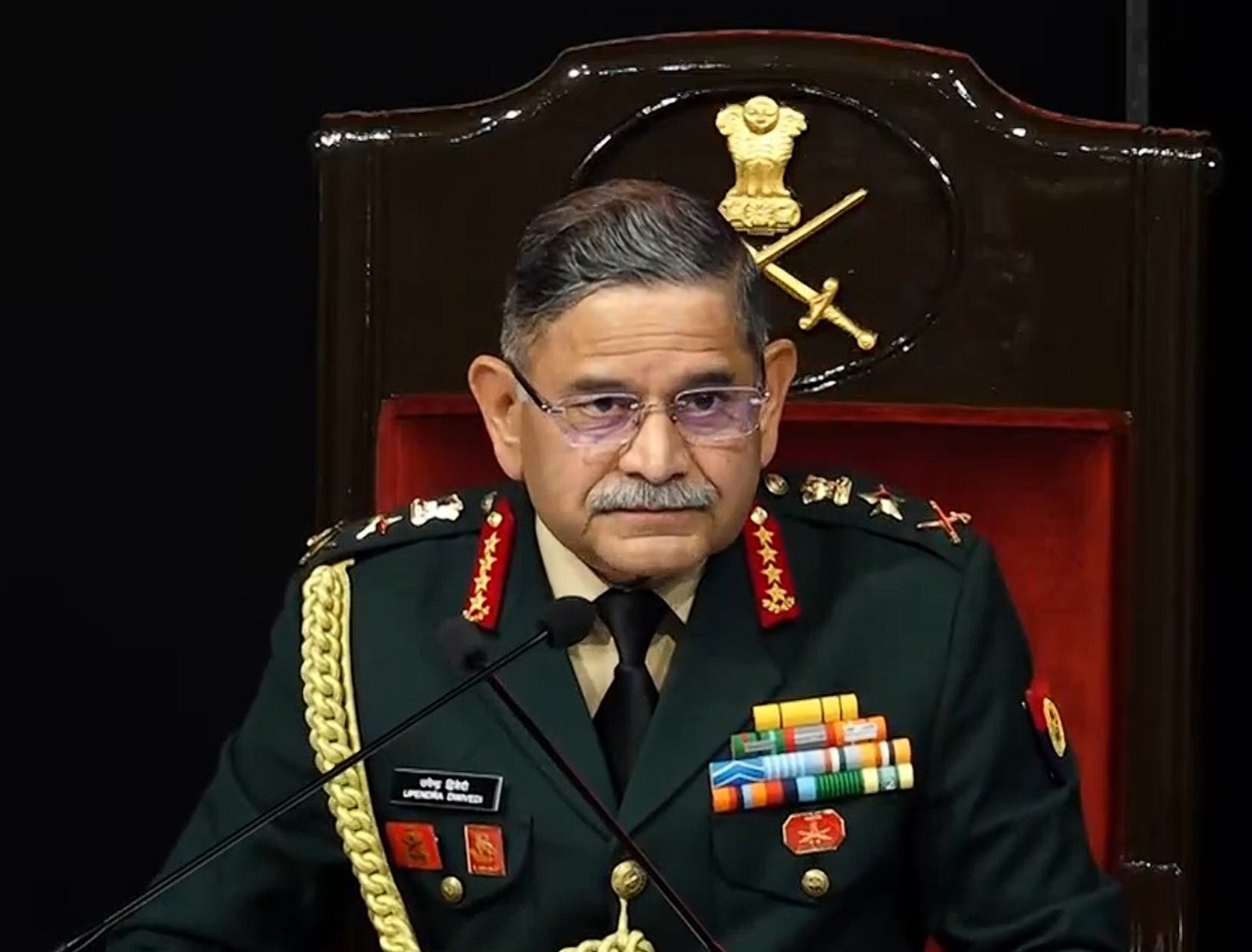
Indian Army Chief General Upendra Dwivedi on Tuesday highlighted the Army’s expansive role in humanitarian assistance, internal security and border preparedness, underscoring that the force remains fully motivated, operationally alert and prepared for any eventuality. Addressing the annual press conference of the Indian Army, Gen Dwivedi said the past year demonstrated the Army’s ability to respond simultaneously to disasters, terrorism and evolving security challenges across multiple fronts.
The Army Chief said that under its Humanitarian Assistance and Disaster Relief (HADR) mandate, the Indian Army carried out operations across two neighbouring countries and 10 Indian states, rescuing more than 30,000 people in 2025. These missions, he said, reaffirmed the Army’s role as the country’s natural first responder during crises. He recalled the daring rescue of CRPF personnel during the Punjab floods in Pathankot, where Army aviation helicopters evacuated personnel from a collapsing building amid extreme conditions.
Internationally, the Indian Army extended assistance to Sri Lanka under Operation Sagar Bandhu during and after Cyclone Ditwah, and to Myanmar under Operation Brahma following a powerful earthquake. Domestically, Gen Dwivedi noted that in several border states, division commanders were empowered to act even before formal requests were received from state authorities, enabling faster response and coordination during emergencies.

Paying tribute to the sacrifices made during such missions, the Army Chief mentioned the efforts of 14 Raj Rifles in Dharali, Uttarakhand, where one Junior Commissioned Officer and nine other ranks lost their lives. Despite the losses, the unit continued rescue operations and coordination in the crucial initial stages. “That is what military motivation is all about,” he said. He also said the Army’s plan to establish 17 dedicated HADR “Bricks” across the country is gradually taking shape, strengthening rapid disaster response capabilities with specialised equipment and trained personnel.
On the security front, Gen Dwivedi said the situation along the northern and north-western borders remains stable and under firm control, though constant vigilance is essential. He noted that apex-level military interactions, renewed contact and confidence-building measures have contributed to gradual normalisation along the northern borders, allowing activities such as grazing and medical camps to resume. Deployment along the Line of Actual Control, he said, remains balanced and robust, with infrastructure development and capability enhancement progressing through a whole-of-government approach.
Speaking on Jammu and Kashmir, the Army Chief said the Union Territory witnessed a significant positive change in 2025, with terrorism steadily declining and development gaining momentum. He said 31 terrorists were eliminated during the year, 65 per cent of whom were of Pakistani origin, including the perpetrators of the Pahalgam terror attack. Active local terrorists are now in single digits, and terrorist recruitment has nearly dried up, with only two cases reported in 2025. Citing the peaceful conduct of the Shri Amarnath Yatra, which saw over four lakh pilgrims, Gen Dwivedi said the theme of “terrorism to tourism” is gradually taking shape in J&K.

Referring to India’s response to cross-border terrorism, the Army Chief said Operation Sindoor was conceptualised and executed with precision following the Pahalgam attack. Initiated within 22 minutes on May 7 and sustained over 88 hours until May 10, the operation struck deep, dismantled terror infrastructure and reset strategic assumptions. The Army successfully destroyed seven out of nine identified targets and played a pivotal role in ensuring a calibrated response to Pakistani actions.
Gen Dwivedi reiterated that Operation Sindoor remains ongoing and warned that any future misadventure would be resolutely responded to. He said the Army had already mobilised its forces and remains fully prepared for ground offensives if required. Highlighting global security trends, he noted a sharp rise in armed conflicts worldwide, underscoring the importance of preparedness. Operation Sindoor, he said, demonstrated India’s readiness, precision and strategic clarity, and stood as a strong example of tri-service synergy under clear political direction and full operational freedom.