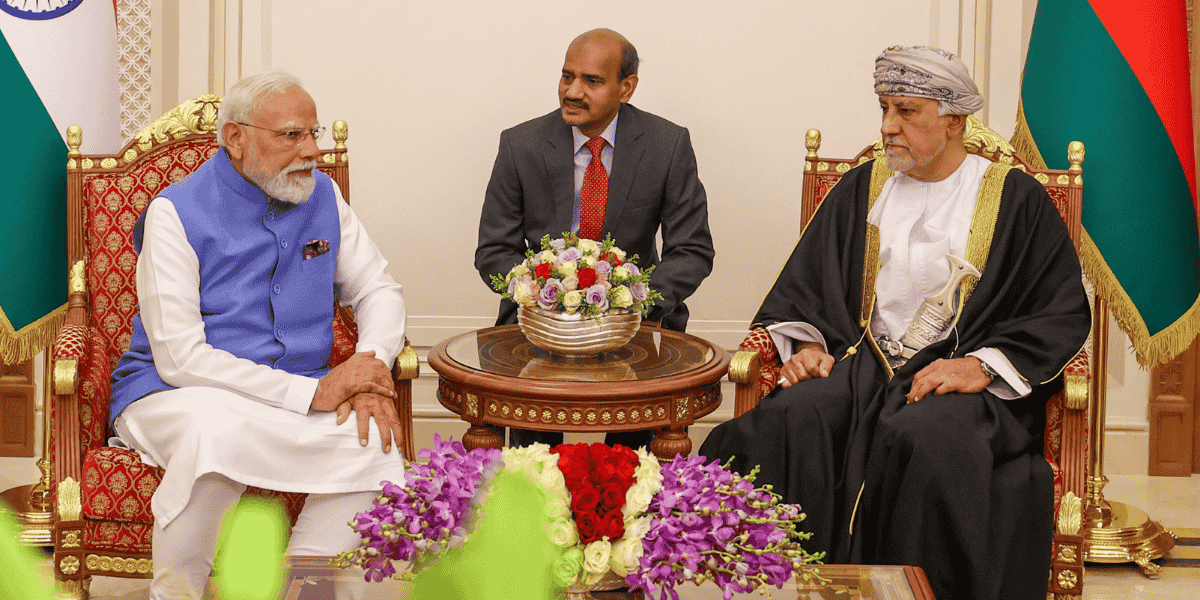
The proposed India–Oman Free Trade Agreement (FTA) is expected to mark a significant step in deepening India’s economic engagement with the Gulf region, with a focus on expanding trade, investments and long-term supply chain resilience.
The agreement, currently under discussion, would be Oman’s second FTA with an individual country and its first such agreement in nearly two decades. Officials see it as a defining milestone in bilateral relations, aimed at improving market access, encouraging two-way investments and strengthening cooperation across several key sectors.
The proposed FTA comes at a time of global economic realignment and is expected to support trade diversification and supply chain resilience for both countries. Indian investments in Oman have more than tripled since 2020, reaching around $5 billion. These investments span sectors such as green steel, green ammonia, aluminium manufacturing and logistics, underlining India’s growing confidence in Oman as a stable, long-term operating base in the region.

Speaking at the India–Oman Business Forum in Muscat on Wednesday, Commerce and Industry Minister Piyush Goyal said the proposed agreement would open up significant opportunities across a wide range of sectors. These include textiles, food processing, automobiles, gems and jewellery, agrochemicals, renewable energy and auto components.
Goyal also highlighted Oman’s strategic geographic position, describing it as a gateway to the Gulf Cooperation Council (GCC), Eastern Europe, Central Asia and Africa. This, he said, offers Indian businesses enhanced access to multiple regional markets through Oman.
The India–Oman FTA fits into India’s broader trade strategy, which has seen the country sign multiple trade agreements in recent years to strengthen exports, attract investments and diversify economic partnerships. These agreements are already delivering benefits to farmers, traders and exporters, officials have said.
Earlier this year, India concluded the Comprehensive Economic and Trade Agreement (CETA) with the United Kingdom, which is expected to reduce tariffs on more than 90 per cent of traded goods and significantly expand bilateral trade. In 2024, India signed a trade and economic partnership with the European Free Trade Association (EFTA), comprising Switzerland, Norway, Iceland and Liechtenstein, which has brought in strong investment commitments.

India’s Economic Cooperation and Trade Agreement (ECTA) with Australia, signed in 2022, cut or eliminated tariffs on most traded goods and opened new avenues for Indian exports. Similarly, the Comprehensive Economic Partnership Agreement (CEPA) with the United Arab Emirates in 2022 reduced tariffs on over 90 per cent of Indian exports, boosting trade in sectors such as gems and jewellery, textiles, leather and engineering goods.
India’s first Africa-focused trade pact with Mauritius in 2021 also improved market access and positioned the island nation as a gateway to the African continent.
Officials say the proposed India–Oman FTA builds on this expanding network of agreements and reflects India’s long-term, foresighted trade strategy focused on resilience, diversification and mutually beneficial growth. Once concluded, the agreement is expected to further consolidate India–Oman economic ties and strengthen India’s footprint in the Gulf region.