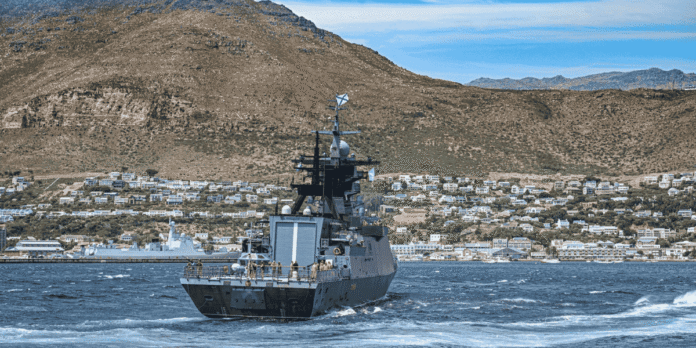
India on Saturday clarified that a recently concluded naval exercise held off the coast of Cape Town was not an official or institutionalised BRICS activity, responding to media queries over its non-participation in the multinational maritime drill.
The Ministry of External Affairs stated that the exercise, referred to as “Exercise Will for Peace 2026,” was initiated by South Africa and involved participation from only some BRICS Plus countries. It stressed that India has not taken part in similar exercises in the past and that the event did not include all BRICS members.
Addressing questions on India’s absence from the exercise, MEA spokesperson Randhir Jaiswal said the drill was “entirely a South African initiative” and should not be described as a BRICS naval exercise. He noted that it was neither a regular nor an institutionalised activity under the BRICS framework.

Jaiswal added that India’s consistent multilateral naval engagement with South Africa and Brazil takes place through the IBSAMAR maritime exercise, which is a formal and established trilateral engagement. The most recent edition of IBSAMAR was conducted in October 2024.
The clarification came amid reports and commentary suggesting that India had opted out of a BRICS naval exercise, prompting the government to outline its position on the nature of the event and its participation policy.
According to the South African defence ministry, Exercise Will for Peace 2026 was hosted in South African waters from January 9 to January 16 and involved a China-led, joint, interagency and multinational naval deployment. The exercise brought together naval forces from select BRICS Plus countries for coordinated maritime operations.
In a statement issued late last month, the South African government said the exercise focused on maritime safety operations, interoperability drills and maritime protection activities. The participating nations jointly adopted the theme “Joint Actions to Ensure the Safety of Shipping and Maritime Economic Activities,” aimed at strengthening cooperation to safeguard sea lanes and maritime trade.
The Chinese Defence Ministry confirmed the participation of the guided-missile destroyer Tangshan and the supply ship Taihu from the People’s Liberation Army Navy. Other vessels involved included the Russian Navy’s corvette Stoikiy and the South African Navy’s frigate Amatola.

Chinese officials said the exercise featured formation manoeuvres, maritime strike simulations, rescue operations involving hijacked vessels, and joint search and rescue missions. Additional drills covered communication protocols, anchorage defence and air defence coordination, with participating forces operating under a unified command structure during certain phases.
India’s statement underscored that while it remains engaged in maritime cooperation with partner nations, its participation is guided by established frameworks and regularised exercises. The government reiterated that IBSAMAR remains the primary naval exercise linking India, Brazil and South Africa, distinguishing it from ad hoc or host-led multinational drills.
The clarification is seen as part of India’s broader effort to maintain clarity on its defence engagements and avoid mischaracterisation of its role within multilateral groupings such as BRICS, particularly amid evolving geopolitical and maritime security dynamics.