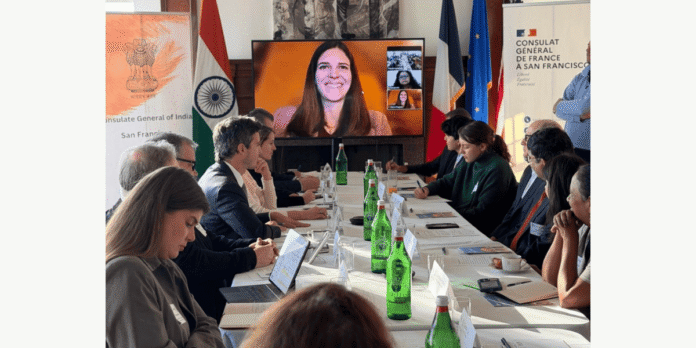
India and France have positioned the upcoming AI Impact Summit in New Delhi as a significant moment in global artificial intelligence governance, emphasising inclusion, development priorities, and measurable outcomes over abstract regulatory debates.
Speaking at a panel discussion during a conference organised by the Center for Strategic and International Studies (CSIS), Indian Ambassador to the United States Vinay M Kwatra and French Ambassador Laurent Bili said the February summit would expand the global AI agenda by bringing perspectives from the Global South to the centre of international discussions.
Kwatra said the New Delhi summit marks the first time a major global conference on artificial intelligence is being hosted in a Global South country. He described the development as significant for broadening how AI governance is framed globally.

According to Kwatra, the summit is structured around three central pillars: people, planet, and progress, with a focus on ensuring that artificial intelligence technologies are accessible, scalable, and beneficial beyond advanced economies. He said the objective is to democratise access to AI and ensure that its deployment addresses societal needs across diverse populations.
The emphasis on “impact,” Kwatra said, reflects a conscious move away from theoretical or purely regulatory discussions toward implementation and real-world outcomes. He underlined that global societies must now focus on deploying AI solutions that deliver tangible benefits.
Bili said the New Delhi summit builds on cooperation initiated during the Paris AI Action Summit in 2025, which shifted international conversations towards investment and applied uses of artificial intelligence. He said India and France aim to deepen this approach by prioritising implementation.
According to Bili, the Delhi summit will include several side events focusing on sustainable AI and applications that serve public interest objectives. He added that the intent is to advance discussions from policy formulation to practical execution.
Both ambassadors said the summit would also address the need to avoid fragmented global AI regulations while recognising that countries may adopt different national approaches to governance.
Kwatra said the event is being designed as a “full-stack AI summit,” bringing together multiple layers of the ecosystem. The programme is expected to include an AI expo with hundreds of exhibitors, research-focused symposiums, CEO-level roundtables, and the adoption of a leaders’ declaration.

Bili highlighted that the Paris summit helped catalyse substantial investments in France and across Europe, including funding for computing infrastructure and research capabilities. He said similar momentum is now visible in India.
Kwatra said India is witnessing significant investment by global technology companies in AI infrastructure, compute capacity,India–France Project New Delhi AI Summit as Shift in Global AI Governance , and energy resources. He noted that India’s large population and rapid digital adoption make it a critical environment for testing AI deployment at scale.
The AI Impact Summit is scheduled to be held in New Delhi in February 2026 and will follow previous global AI summits hosted by the United Kingdom, South Korea and France. Organisers expect the event to play a central role in shaping the next phase of international cooperation on artificial intelligence governance.