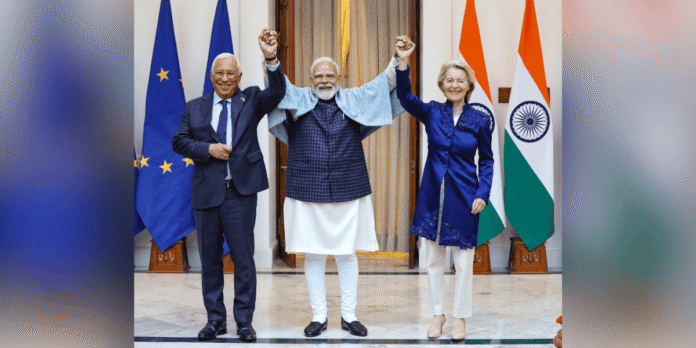
Prime Minister Narendra Modi on Friday said the India–European Union free trade agreement is fully aligned with the government’s vision of transforming India into a developed nation, describing the pact as a major step in strengthening the country’s economic diplomacy.
The Prime Minister highlighted an article authored by Commerce Minister Piyush Goyal, which termed the agreement a transformative deal that expands markets, generates employment and safeguards India’s core economic interests. The Prime Minister underscored that the agreement reflects India’s growing role in shaping global trade frameworks.
According to the article, the India–EU free trade agreement marks a significant milestone in India’s external economic engagement and is expected to generate millions of jobs while opening new opportunities for youth, farmers and businesses. The pact covers economies that together represent nearly a quarter of global output and a combined population of around two billion people.

The agreement, signed between the world’s second- and fourth-largest economies, ranks among the largest trade deals globally. Beyond tariff reductions, it establishes a broader strategic partnership aimed at deepening cooperation in sectors such as artificial intelligence, defence manufacturing and semiconductors. The article noted that the agreement is expected to benefit citizens across all regions of India.
A key feature of the pact is the emphasis on predictable and rules-based trade, which is expected to enhance investor confidence and policy stability. This, in turn, is likely to attract both domestic and foreign investment while creating opportunities for startups, small businesses and workers across multiple sectors.
The article stated that the agreement has received global attention, with international observers describing it as the “mother of all deals” amid ongoing disruptions in global trade and supply chains. It positions India and the European Union as long-term partners committed to open markets, stability and inclusive growth.
Under the agreement, India has secured market access for over 99 per cent of its exports to the EU by trade value, providing a significant boost to the Make in India programme. Labour-intensive sectors including textiles, apparel, leather, footwear, marine products, gems and jewellery, handicrafts, engineering goods and automobiles are expected to benefit substantially.

The pact will remove tariffs of up to 10 per cent on nearly $33 billion worth of Indian exports, strengthening the competitiveness of Indian goods in European markets. It is also expected to support artisans, workers, women, youth and micro, small and medium enterprises by integrating them more closely into global value chains.
In addition, the agreement facilitates easier mobility for professionals and businesspersons and opens expanded opportunities in services such as information technology, education, financial services and computing. These provisions are expected to create high-value employment and reinforce India’s position as a global hub for skilled talent, innovation and sustainable economic growth.
The Prime Minister reiterated that the India–EU free trade agreement represents a comprehensive economic partnership and a key pillar of India’s long-term growth strategy.