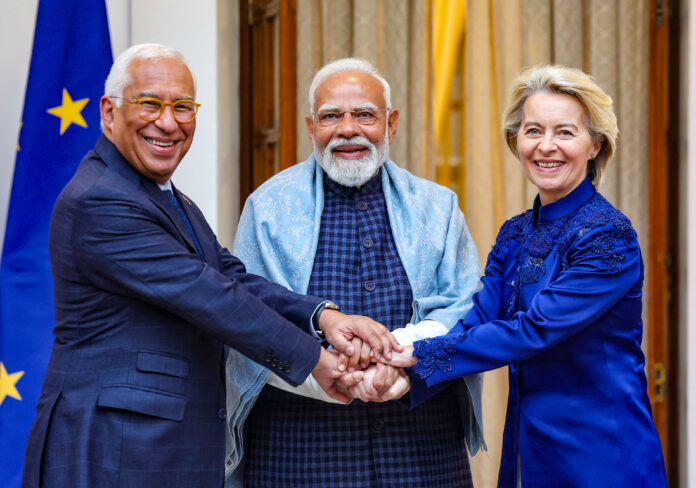
India and the European Union on Tuesday announced the conclusion of a long-negotiated Free Trade Agreement (FTA), marking one of the most significant economic partnerships between the two regions and creating a trade zone covering nearly two billion people. The development was confirmed by European Commission President Ursula von der Leyen, who described the pact as the “mother of all deals,” signalling its scale and strategic importance.
The announcement came following high-level meetings in New Delhi, where Prime Minister Narendra Modi hosted European Commission President Ursula von der Leyen and European Council President Antonio Costa. Leaders on both sides framed the agreement as a transformative step in deepening economic and strategic ties between India and the EU, ending nearly 18 years of negotiations.
Under the agreement, tariffs on a large share of Indian exports to the EU are set to be reduced or eliminated, with sectors such as textiles, gems and jewellery, leather, and manufacturing expected to benefit. At the same time, India’s market is expected to see increased access for European automobiles, industrial machinery, and advanced technologies. Officials said the pact aims to create a more balanced and rules-based trade environment while strengthening supply chain resilience.

The deal is expected to come into force next year, after legal and procedural processes are completed on both sides. Beyond trade, the summit discussions covered a wide range of issues, including defence and security cooperation, climate action, critical and emerging technologies, and collaboration in shaping global governance frameworks.
European Council President Antonio Costa underlined the broader geopolitical context, stating that the partnership is intended to deliver tangible benefits to citizens while strengthening cooperation on global challenges. The EU’s outreach to India comes at a time when Europe is seeking to diversify economic and diplomatic relationships amid shifting global alignments and supply chain vulnerabilities.

Indian officials described the agreement as a qualitative leap in bilateral ties, noting that the FTA goes beyond tariffs to include regulatory cooperation, investment facilitation, and strategic sector partnerships. Observers say the pact could boost manufacturing, exports, and job creation in India, while providing European companies with deeper access to one of the world’s fastest-growing large markets.
The summit at Hyderabad House also signalled closer defence and strategic coordination, with both sides expected to move forward on a defence cooperation framework and a broader strategic agenda. Climate change mitigation, digital governance, and emerging technologies were highlighted as priority areas for future collaboration.
With global trade patterns undergoing rapid shifts, the India-EU agreement is being seen as a major step toward strengthening multipolar economic partnerships and reducing overdependence on any single region. The pact positions both sides to play a more prominent role in shaping trade norms and economic governance in the coming decade.