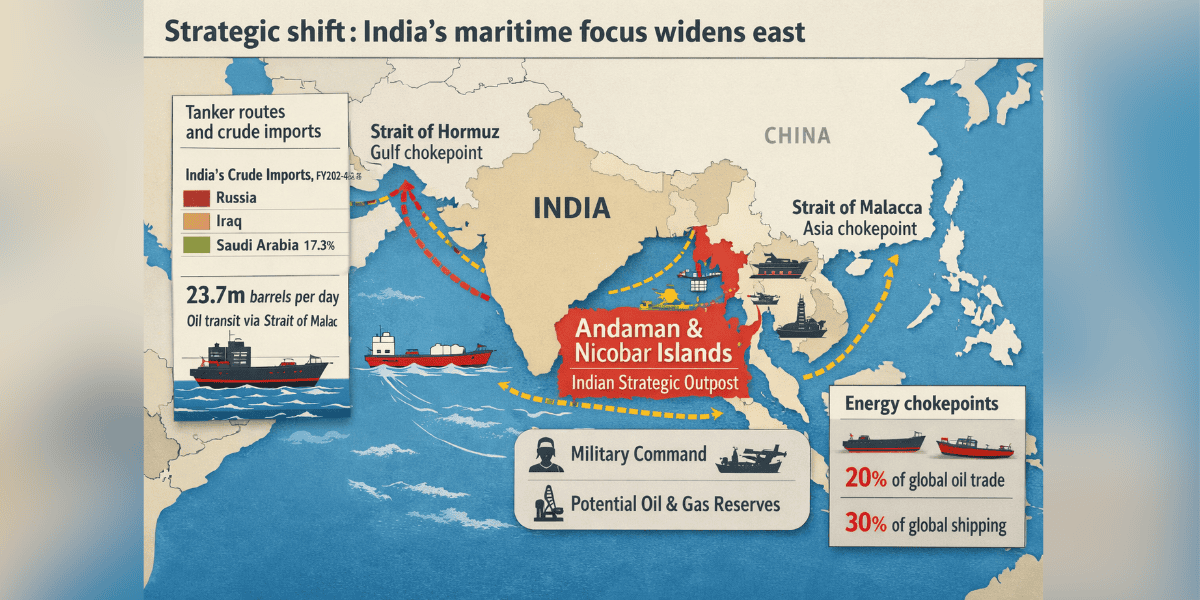
As tensions in the Middle East keep oil markets volatile and the vulnerability of the Strait of Hormuz remains in focus, defence and energy security experts say India’s strategic calculus is widening beyond the Gulf. While Hormuz continues to represent the most immediate supply risk, attention is increasingly turning east, towards the Strait of Malacca and the geographic leverage offered by the Andaman and Nicobar Islands.
India’s dependence on imported crude makes Hormuz a structural vulnerability. The US Energy Information Administration estimates that more than a quarter of global seaborne oil trade moved through Hormuz in 2024 and early 2025, with Asian markets the primary destination. Any sustained disruption would tighten supplies, lift freight and insurance costs, and quickly transmit price pressure into the domestic economy.
But India’s energy map has been evolving. Official trade data show Russia accounting for 35.8% of India’s crude imports in FY2024–25, making it the country’s largest supplier ahead of Iraq, Saudi Arabia, the UAE and the United States. As sourcing diversifies, maritime exposure spreads beyond West Asia and deeper into Indo-Pacific sea lanes.

Why Malacca matters
The Strait of Malacca, which links the Indian Ocean with the Pacific via the South China Sea, is the world’s largest oil transit chokepoint by volume. The US EIA estimates that about 23.7 million barrels per day of crude and petroleum liquids flowed through Malacca in 2023 — more than through any other maritime chokepoint globally.
While crude shipments from the Gulf to India do not transit Malacca, the corridor already anchors the broader Asian energy ecosystem in which India operates. Russian Far East crude, Pacific-facing suppliers, refined petroleum products and LNG cargoes moving across East and Southeast Asia intersect with the South China Sea system feeding into Malacca before entering the Indian Ocean.
Energy analysts note that in a prolonged Middle East crisis, India would likely draw incremental barrels from non-Gulf suppliers. The sustainability of that diversification depends on stable Indo-Pacific shipping corridors. In that framework, Malacca underwrites resilience, not as a substitute for Hormuz, but as the corridor that sustains alternative flows.
“In a short disruption, Hormuz is the pressure point,” said an energy security expert tracking maritime routes. “If volatility persists, the question becomes whether alternative sea lanes remain secure. Malacca sits at the centre of that equation.”

Island leverage
That equation places the Andaman and Nicobar Islands in sharper focus. Located near the western approaches to the Strait of Malacca, the islands overlook critical shipping lanes connecting the Bay of Bengal to Southeast Asia. Their position gives India forward presence along one of the busiest energy corridors in the world.
The tri-services Andaman and Nicobar Command, headquartered at Sri Vijaya Puram, is India’s only integrated theatre command, combining the Army, Navy, Air Force and Coast Guard under a unified operational structure tasked with safeguarding national interests in the Indian Ocean Region. Defence analysts say this enhances maritime domain awareness and operational reach across eastern sea lanes.
The Indian Coast Guard’s regional headquarters in Sri Vijaya Puram further underscores the concentration of maritime oversight infrastructure in the territory.
Beyond sea-lane security, another factor is raising the islands’ strategic profile: the growing expectation of hydrocarbon potential in the Andaman Sea. The Oil and Natural Gas Corporation and the Ministry of Petroleum and Natural Gas have in recent years intensified exploration efforts in deepwater blocks around the Andaman basin under India’s open acreage licensing framework. Preliminary geological assessments have suggested that the basin may hold significant untapped oil and gas resources, though commercial discoveries are yet to be confirmed at scale.
Energy sector experts say that even the prospect of meaningful hydrocarbon finds in the Andaman Sea elevates the islands’ importance by several notches. “If commercially viable reserves are discovered, the islands would shift from being purely a strategic maritime outpost to becoming directly linked to upstream energy production,” said a senior industry analyst. “That changes the security calculus entirely.”
Such a development would intertwine energy production, shipping security and defence posture in a single geography. Infrastructure for offshore exploration, subsea pipelines and potential LNG handling would further increase the strategic sensitivity of the region.
“In the Andamans, geography already translates into leverage,” said a former naval officer familiar with eastern theatre operations. “Add the possibility of domestic hydrocarbon production in surrounding waters, and the strategic weight of the islands rises significantly.”