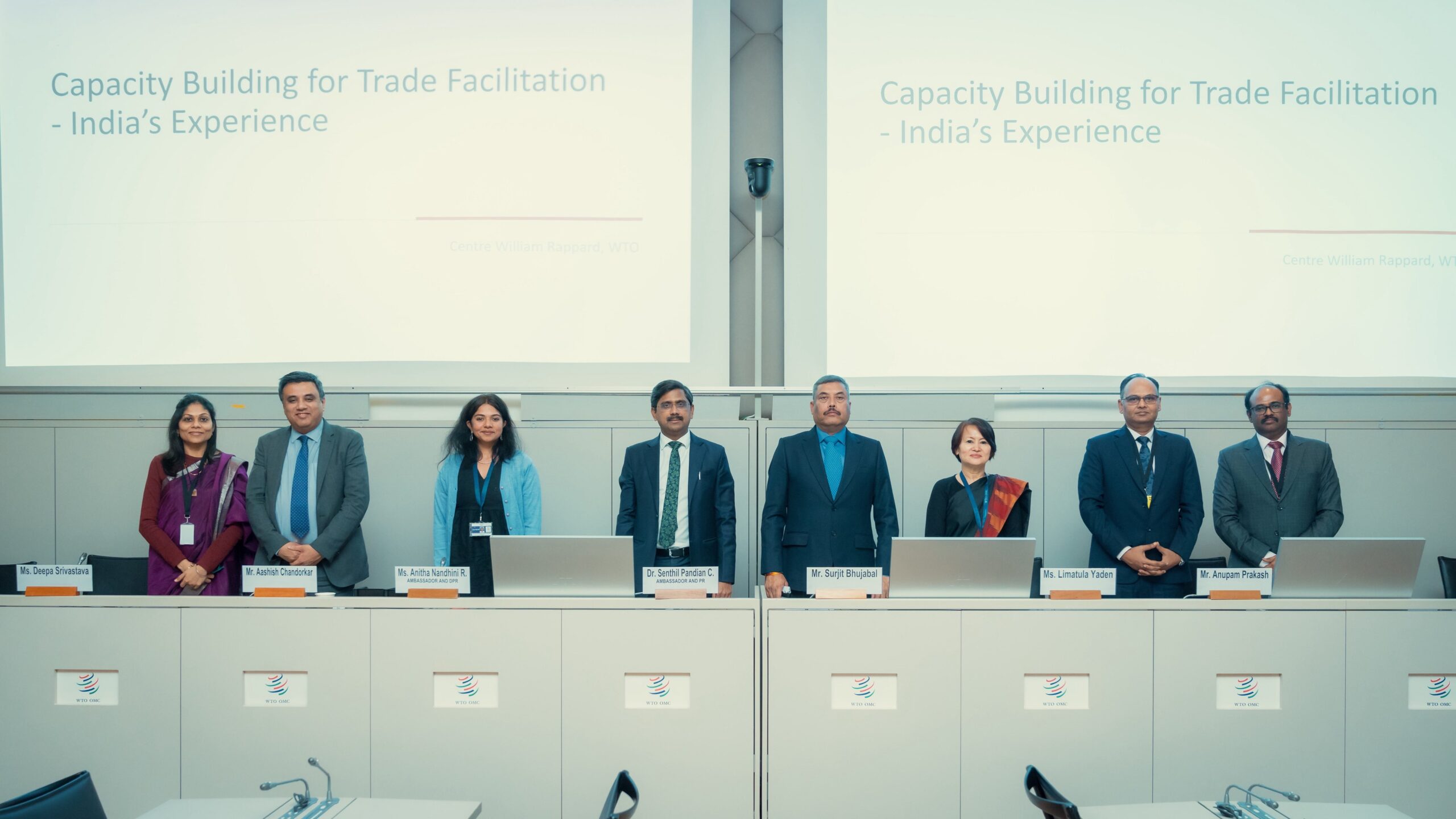
India presented its customs digitalisation and trade facilitation initiatives to global delegates during special sessions on the sidelines of the Committee on Trade Facilitation at the World Trade Organisation (WTO) in Geneva. The sessions, held on February 24, focused on enhancing trade processes and capacity building, ahead of India’s 8th Trade Policy Review scheduled for July 2026.
Organised jointly by the Central Board of Indirect Taxes and Customs (CBIC) and the Permanent Mission of India to the WTO, the event saw participation from representatives of around 40 countries. Officials highlighted India’s compliance with the WTO Trade Facilitation Agreement (TFA) and shared best practices under the National Trade Facilitation Action Plan (NTFAP 3.0), which aims to exceed minimum TFA requirements.

During the trade facilitation session, India’s delegation detailed its “whole-of-government” approach to customs reforms, focusing on a faceless, contactless, and paperless customs ecosystem. Advanced systems showcased included the comprehensive customs automated system with single-window interface, a robust risk management system (RMS), and the Authorised Economic Operator (AEO) programme. Officials highlighted that India has notified 100 percent of its TFA commitments within prescribed timelines, reflecting sustained efforts to streamline cross-border trade, improve transparency, and coordinate inter-agency operations.
The capacity-building session emphasised India’s role in training officers from developing and least-developed countries through the National Academy of Customs, Indirect Taxes & Narcotics (NACIN) and the Central Revenue Control Laboratory (CRCL). NACIN, recognised by the World Customs Organization (WCO) as the Regional Training Centre for Asia-Pacific, has conducted 65 international training sessions since 2022, benefiting over 1,800 participants from 30 countries. CRCL trained more than 300 international participants in laboratory and compliance procedures. India expressed its willingness to collaborate further with countries to strengthen their trade facilitation capabilities.

Surjit Bhujabal, Special Secretary and Member (Customs), stressed that India’s digital customs infrastructure has reduced transaction costs, shortened clearance times, and strengthened integration into global value chains. He noted that the digital ecosystem connects traders, customs authorities, banks, and logistics operators, enhancing efficiency across the entire import-export chain.
Officials highlighted that India’s reforms and capacity-building efforts have garnered global appreciation for providing a scalable model of digital trade facilitation, reflecting the country’s commitment to aligning domestic processes with international best practices.
The sessions underscored India’s dual focus on modernising customs procedures and extending expertise internationally, reinforcing the nation’s role as a leader in trade facilitation and global customs capacity building.