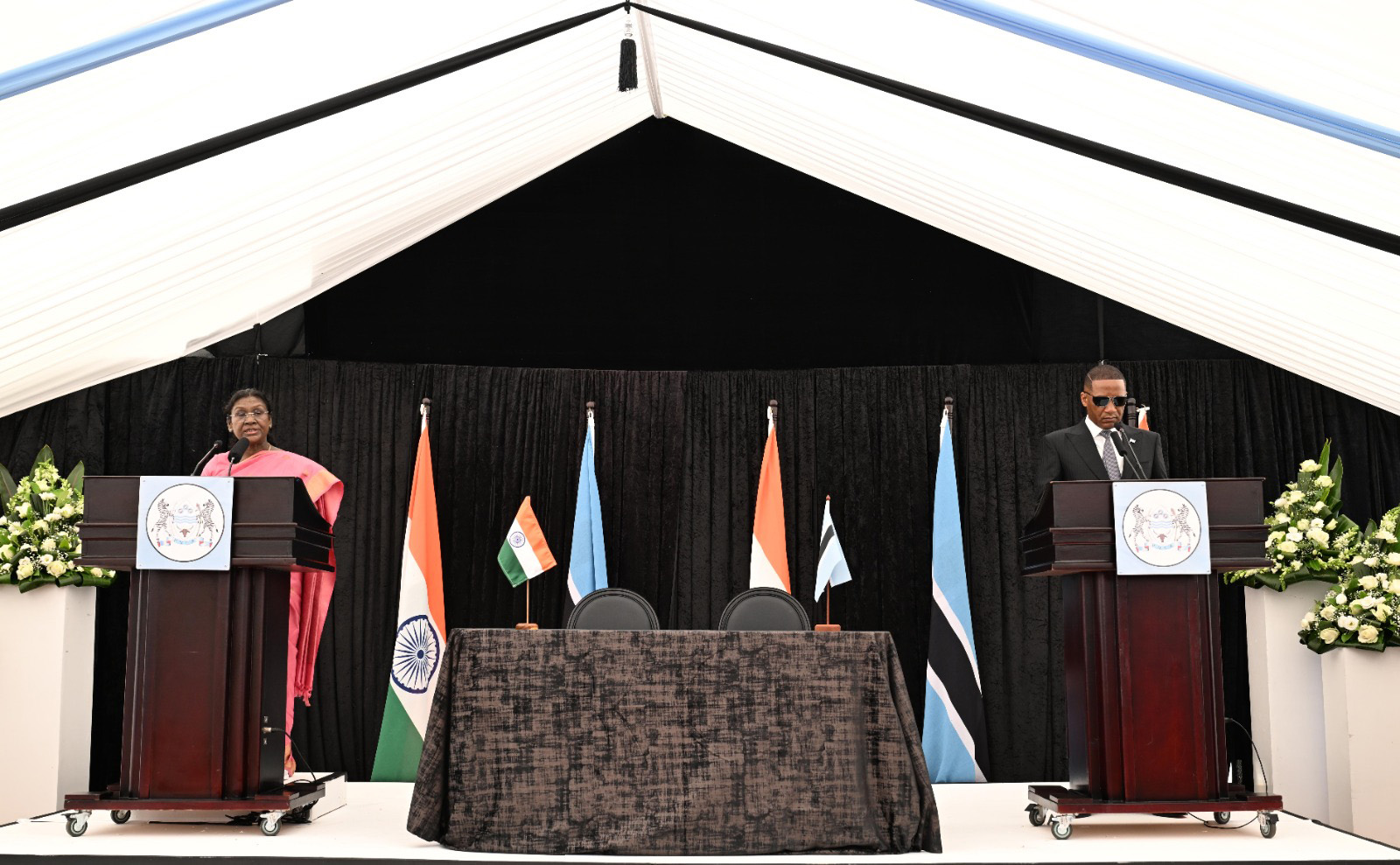
In a landmark diplomatic engagement, Botswana President Advocate Duma Gideon Boko described India as the “mother of democracy”, acknowledging its enduring role as a source of inspiration and steadfast partner in Botswana’s development journey. The statement came as President Droupadi Murmu arrived in Gaborone on the first-ever State Visit by an Indian President to Botswana, underscoring the deepening partnership between the two nations.
Welcoming President Murmu with full ceremonial honours, President Boko highlighted India’s significant contributions to education, gender equality, and social empowerment, lauding Murmu’s own leadership in championing these causes. He emphasized that this was the first State Visit hosted by Botswana since he assumed office last year, a gesture reflecting the country’s high regard for its ties with India.
During wide-ranging discussions held both one-on-one and at the delegation level, the two leaders agreed to expand cooperation in key sectors such as trade and investment, agriculture, renewable energy, healthcare, education, skill development, defence, and digital technology. The talks also reaffirmed the shared commitment to sustainable growth, technological collaboration, and people-to-people exchanges.
President Murmu noted that the visit marks an important milestone in bilateral relations, coming ahead of the 60th anniversary of the establishment of diplomatic ties between India and Botswana in 2026. She reaffirmed India’s commitment to working closely with Botswana to deepen partnerships across sectors and to continue engagement with Africa through platforms like the India-Africa Forum Summit.
Among the key outcomes of the visit was the signing of a pharmacopoeia agreement, which will enable easier access to quality and affordable Indian medicines for Botswana’s citizens. India also announced its decision to supply essential antiretroviral (ARV) medicines, responding to a request from the Government of Botswana, as part of its ongoing health cooperation initiatives.
Another notable highlight of the meeting was the discussion on Project Cheetah, India’s ambitious wildlife restoration programme. President Murmu expressed gratitude to President Boko and the people of Botswana for agreeing to send cheetahs to India under the next phase of the project. She described it as a “unique wildlife conservation initiative” that seeks to restore the cheetah population to India’s ecosystems after more than seven decades.
The visit also included several symbolic and strategic engagements. President Boko personally received President Murmu at the airport, where she was accorded a ceremonial welcome and guard of honour upon her arrival from Angola. Murmu is also scheduled to address Botswana’s National Assembly, interact with the Indian community, and visit sites of cultural and historical significance during her stay.
The Ministry of External Affairs (MEA) underscored the significance of the visit, noting its alignment with Botswana’s Vision 2036, a roadmap to transform the nation into a high-income, diversified economy. MEA Secretary (Economic Relations) Sudhakar Dalela said the visit would help identify key areas of collaboration where Indian businesses can partner with their Botswana counterparts, particularly in technology, infrastructure, and human resource development.
The Indian President is accompanied by Minister of State for Jal Shakti and Railways V. Somanna, and Members of Parliament Parbhubhai Nagarbhai Vasava and D.K. Aruna. The delegation earlier visited Angola, where Murmu attended the 50th anniversary of Angola’s Independence, addressed the National Assembly of Angola, and held talks with President Joao Manuel Goncalves Lourenco.
President Murmu’s visit to Botswana represents a significant chapter in India’s diplomatic outreach to Africa, strengthening historical bonds rooted in democracy, development, and mutual respect. With renewed commitments in trade, healthcare, and environmental conservation, the engagement signals a deepening partnership grounded in shared democratic ideals and sustainable progress.