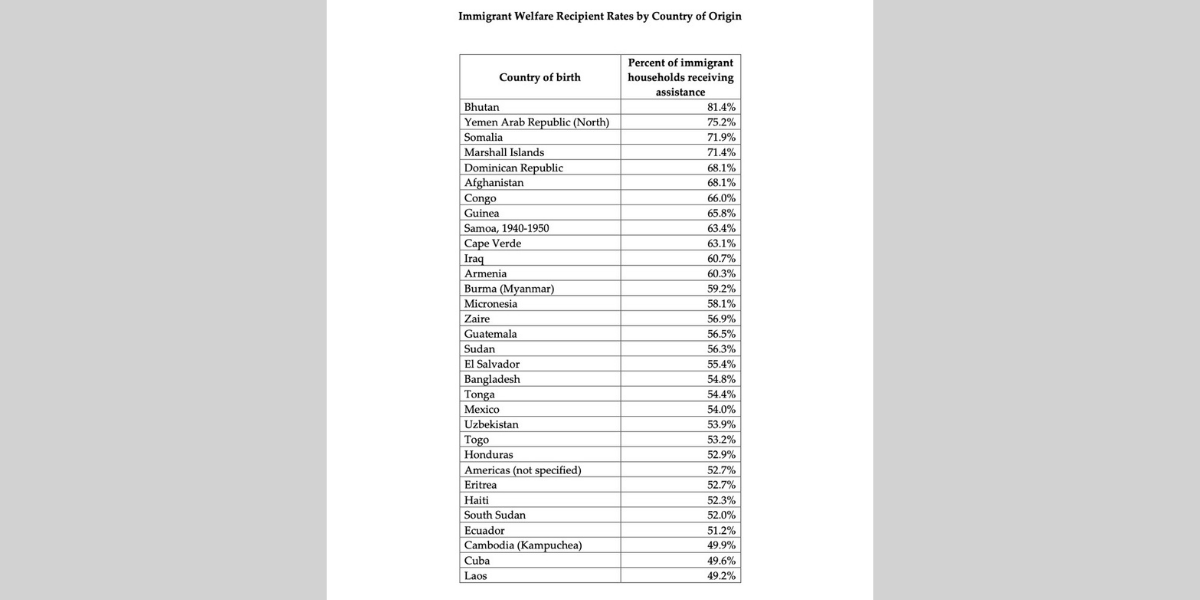
Data tables shared by US President Donald Trump on his social media platform Truth Social, ranking immigrant welfare participation by country of origin, have drawn attention in Washington, particularly due to India’s absence from the list. The omission has been viewed as reflective of the distinct economic characteristics of Indian immigrants within the United States.
The dataset, presented across two tables but forming a single compilation, outlines the percentage of immigrant households in the US receiving government assistance. According to the figures, welfare participation rates among listed countries range from over 80 per cent to just below 40 per cent.
Bhutan ranks highest, with 81.4 per cent of immigrant households reportedly receiving welfare benefits. Yemen (North) follows at 75.2 per cent, while Somalia and the Marshall Islands record rates of 71.9 per cent and 71.4 per cent, respectively. Several other nations show similarly high levels of participation in public assistance programmes.

The Dominican Republic and Afghanistan are each listed at 68.1 per cent, while Congo stands at 66 per cent and Guinea at 65.8 per cent. Iraq is recorded at 60.7 per cent. A number of Central American, Caribbean and African countries feature prominently among those with elevated welfare reliance.
Further down the list, Guatemala is shown at 56.5 per cent, Sudan at 56.3 per cent, and El Salvador at 55.4 per cent. Honduras appears at 52.9 per cent, while Bangladesh is listed with a welfare participation rate of 54.8 per cent.
The second table covers countries with comparatively lower, though still significant, levels of welfare usage. Ivory Coast leads this segment at 49.1 per cent, closely followed by Liberia at 48.9 per cent and Algeria at 48.1 per cent. Syria is listed at 48 per cent.
Jordan and Libya are each shown at 47.8 per cent, Ethiopia at 47.6 per cent, Rwanda at 47.1 per cent and Morocco at 46.6 per cent. Pakistan appears with a rate of 40.2 per cent, while Egypt is listed at 39.3 per cent.
India does not feature on either page of the dataset. The absence is notable at a time when immigration and welfare continue to be prominent political issues in the United States.

Multiple public and academic studies over the years have consistently indicated that Indian immigrants rank among the highest earners across ethnic groups in the US. They also demonstrate high rates of workforce participation and comparatively low reliance on government assistance programmes.
Industry and research findings further suggest that Indian immigrants play a significant role in key sectors of the US economy, particularly technology, healthcare and engineering. They are major contributors to income tax revenues and have been involved in founding or co-founding a substantial share of startups, especially in innovation hubs such as Silicon Valley.
The data shared by the US President has reignited discussions around immigration patterns, economic contribution and welfare usage, with India’s exclusion from the list underscoring the contrasting socio-economic profile of its immigrant community.