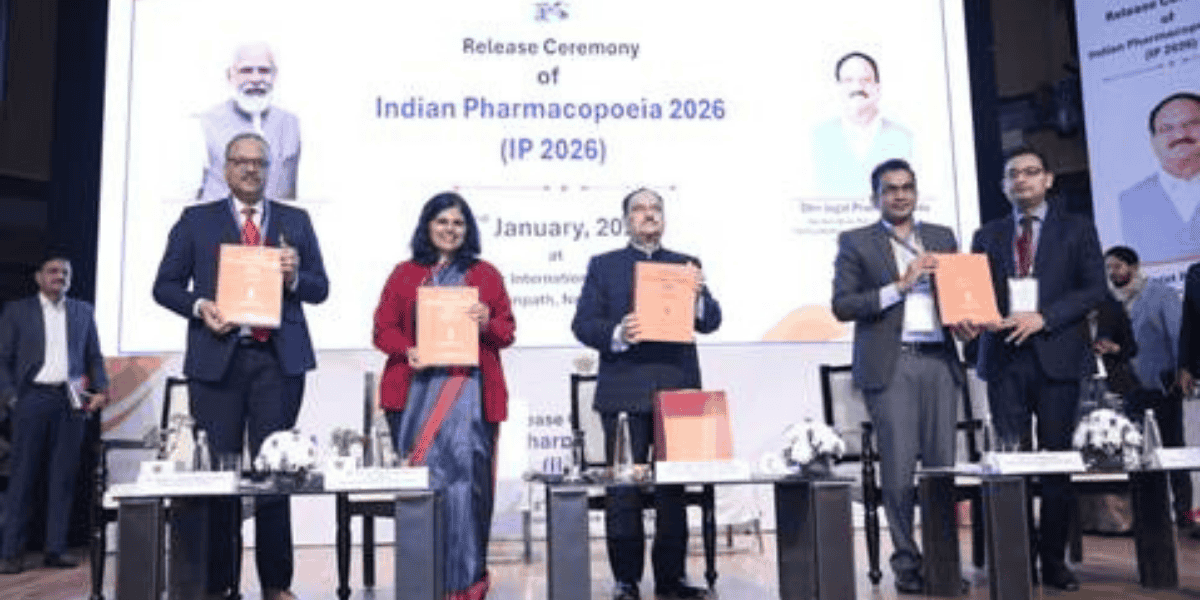
India has made a significant leap in global drug safety monitoring, rising to the 8th position worldwide in contributions to the World Health Organization’s (WHO) pharmacovigilance database, Union Minister for Health and Family Welfare J. P. Nadda said on Friday.
The announcement was made during the release of the Indian Pharmacopoeia 2026 (IP 2026), the 10th edition of India’s official compendium of drug standards, at the Dr. Ambedkar International Centre in New Delhi.
Addressing the gathering, Nadda said the Indian Pharmacopoeia remains a cornerstone of the country’s pharmaceutical regulatory framework, setting authoritative standards for drugs manufactured, sold and consumed in India. He noted that the 2026 edition reflects scientific progress, alignment with global best practices, and India’s expanding leadership in pharmaceutical manufacturing and regulation.

Highlighting the progress of the Pharmacovigilance Programme of India (PvPI), implemented under the Indian Pharmacopoeia Commission (IPC), the minister said India’s global standing has improved dramatically over the past decade. According to him, the country was ranked 123rd in contributions to the WHO’s pharmacovigilance database during the 2009–2014 period but has now climbed to the 8th position globally in 2025.
Nadda said the improvement underscores the strengthening of India’s drug safety monitoring ecosystem and reflects sustained efforts to enhance adverse drug reaction reporting, data quality and regulatory oversight.
The Health Minister also outlined key updates in the Indian Pharmacopoeia 2026, stating that the latest edition includes 121 new monographs, taking the total number to 3,340. He said the expanded coverage strengthens standardisation across critical therapeutic areas such as anti-tubercular, anti-diabetic and anti-cancer medicines, along with iron supplements. These updates, he added, are particularly relevant for medicines supplied under various National Health Programmes.
Commending the IPC and PvPI teams, Nadda said the strengthened pharmacovigilance framework demonstrates India’s commitment to patient safety, quality assurance and robust regulatory vigilance. He added that these efforts are central to building trust in the healthcare system and ensuring safer use of medicines nationwide.

The minister further noted that Indian Pharmacopoeia standards have gained growing international acceptance in recent years. He said the recognition of Indian drug standards has become an important component of India’s health diplomacy, particularly with countries of the Global South. According to Nadda, the Indian Pharmacopoeia is now recognised in 19 countries, reflecting India’s expanding influence in global public health and pharmaceutical regulation.
Highlighting regulatory advancements in the latest edition, Nadda said the Indian Pharmacopoeia 2026 has, for the first time, included 20 blood component monographs related to transfusion medicine. He said the inclusion has been made in line with the provisions of the Drugs and Cosmetics (Second Amendment) Rules, 2020, marking a significant step towards strengthening standards in transfusion services and patient care.
The release of IP 2026, Nadda said, represents a major milestone in India’s ongoing efforts to align its pharmaceutical standards with evolving scientific and regulatory requirements, while reinforcing its role as a responsible global healthcare partner.