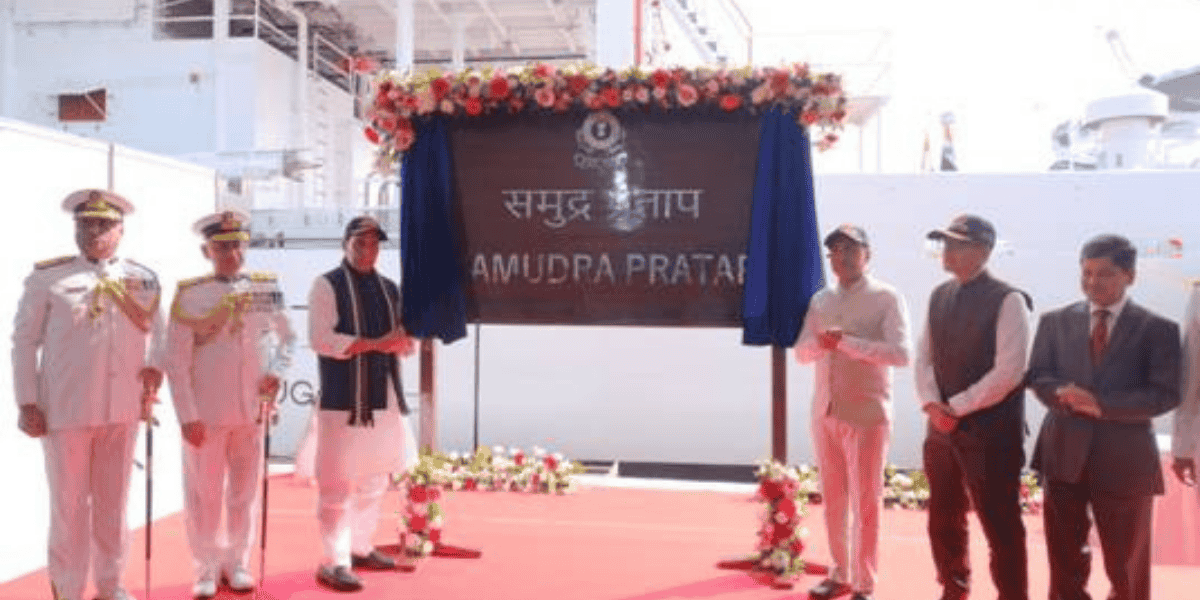
Defence Minister Rajnath Singh on Monday commissioned Indian Coast Guard Ship (ICGS) Samudra Pratap, the first of two Pollution Control Vessels, marking a significant milestone in India’s maritime and environmental protection capabilities.
Describing the vessel as a reflection of India’s evolved defence manufacturing ecosystem, Singh said the commissioning highlights the country’s ability to handle complex shipbuilding requirements through indigenous expertise. With more than 60 per cent indigenous content, Samudra Pratap is India’s first indigenously designed pollution control vessel and currently the largest ship in the Indian Coast Guard (ICG) fleet.
The induction of the vessel is expected to substantially enhance the Coast Guard’s operational capabilities in pollution control, firefighting, maritime safety and environmental protection. Officials said it will also strengthen the ICG’s ability to undertake extended surveillance and response missions across India’s vast maritime zones.

Although primarily designed for pollution response, the ship has been equipped with multiple operational capabilities integrated into a single platform. According to the Defence Minister, this multi-role design will enable Samudra Pratap to effectively carry out coastal patrol duties and reinforce overall maritime safety. He noted that the vessel reflects the modern shipbuilding approach adopted by Goa Shipyard Limited (GSL) to address present-day maritime challenges with greater flexibility and readiness.
The Defence Minister commended the Indian Coast Guard for its expanding role across diverse domains, including marine pollution response, coastal cleanliness, search and rescue operations, and maritime law enforcement. He stated that the Coast Guard’s performance sends a clear signal that any threat or misadventure along India’s maritime borders would be met with a firm and decisive response.
ICGS Samudra Pratap is equipped with advanced pollution detection systems, dedicated pollution response boats and modern firefighting equipment. It also features a helicopter hangar and aviation support facilities, significantly extending its operational reach and effectiveness during emergencies. Singh expressed confidence that these features would allow the vessel to operate stably even in rough sea conditions, providing a critical advantage during real-life operations.

Highlighting the growing environmental challenges posed by climate change and global warming, the Defence Minister described marine environment protection as both a strategic necessity and a moral responsibility. He appreciated the Indian Coast Guard’s role in conducting oil spill response, firefighting and salvage operations, noting that these capabilities place India among a select group of nations with advanced environmental response infrastructure.
Singh further stated that the vessel’s capabilities, including quick detection, precise station-keeping and efficient recovery systems, would ensure timely containment of pollution incidents. This, he said, would help prevent damage to sensitive marine ecosystems such as coral reefs, mangroves and fisheries, while safeguarding marine biodiversity.
He emphasised that protecting the marine environment is directly linked to the sustainability of coastal communities and the growth of the blue economy, underlining the strategic importance of Samudra Pratap in strengthening India’s maritime and environmental security framework.