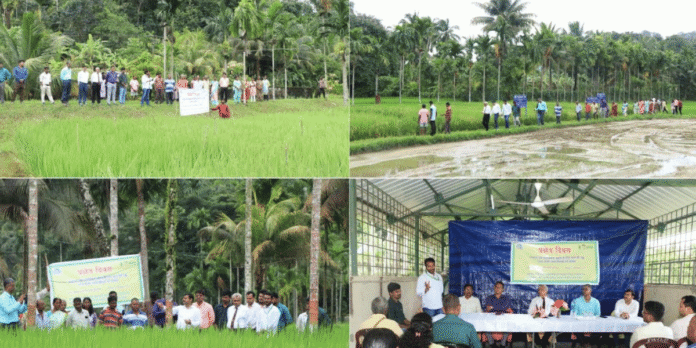
Farmers from Chouldari, Tushnabar, and surrounding villages gathered at the Bloomsdale Research Farm this week for a Field Day organized by the Division of Natural Resource Management, ICAR-Central Island Agricultural Research Institute (ICAR-CIARI). The event, titled “Demonstration of Rice Growth and Yield under Different Transplanting Dates,” aimed to provide practical insights into how transplanting schedules influence crop growth, yield, and resilience.
The programme was held under the guidance of ICAR-CIARI Director, Dr. Eaknath B. Chakurkar, and coordinated by scientists including Dr. Abhilash (Agricultural Meteorology), Dr. P.K. Singh (Plant Breeding and Genetics, Field Crop Improvement), and Dr. Prabhu P. (Plant Genetic Resources). Technical support was extended by staff members Bikash Chand Mondal and Brajesh Kumar. The presence of Heads of Divisions, Krishi Vigyan Kendras, and officials from the Department of Agriculture added weight to the programme.
About 30 farmers actively participated in the event, which began with an inaugural session followed by technical discussions. The focus was on bridging scientific knowledge with farmer practices, ensuring that research findings translate into actionable strategies for local agricultural conditions.

Addressing the farmers, Dr. P.K. Singh spoke about the importance of improved rice varieties adapted to island agro-climatic conditions. He highlighted how these varieties could provide higher yield potential while being resistant to local pests and diseases. Dr. Abhilash stressed the significance of timely nursery raising and transplanting. He explained that even small delays can reduce crop growth, disrupt yield attributes, and compromise water-use efficiency, an important consideration in island farming systems.
Further, Dr. Y. Ramakrishna elaborated on agronomic practices that contribute to higher yields. His session covered nutrient management, spacing between plants, and weed control methods, each playing a vital role in ensuring strong crop establishment and productivity.
In his remarks, ICAR-CIARI Director Dr. Chakurkar highlighted the broader context of timely transplanting in the Andaman and Nicobar Islands. Unlike mainland regions where drought risk is the main concern, the islands face challenges of abundant rainfall, waterlogging, and pest incidence. He emphasized that timely transplanting helps counter these risks by ensuring optimal crop maturity, reducing vulnerability to lodging, and improving grain quality. He urged farmers to adopt climate-smart, location-specific cultivation practices as demonstrated by the institute.
The highlight of the programme was the field visit. Farmers were guided through experimental plots showcasing rice transplanted at different dates. They observed variations in crop establishment, tillering, panicle initiation, and grain filling stages. Scientists explained how early and timely transplanting leads to stronger crop stands, better rainfall utilization, and higher yields compared to delayed schedules.
Farmers used the opportunity to raise questions on varietal performance, nutrient and water management, and pest control. They also shared their own field experiences, allowing for a two-way exchange of knowledge. Scientists responded with practical advice, reinforcing the idea that local adaptation of best practices is essential for success.
The programme concluded with a vote of thanks by Dr. Abhilash, who acknowledged the enthusiastic participation of farmers and support from colleagues. Farmers expressed keen interest in adopting the demonstrated methods, particularly improved rice varieties and timely transplanting schedules, in their own fields.

For participants, the Field Day offered not only exposure to new techniques but also confidence that adopting these practices could improve productivity and profitability. By connecting scientific demonstrations with practical realities, ICAR-CIARI reaffirmed its role in supporting island agriculture with research-driven solutions.
As farming communities across the islands face increasing pressures from climate variability, such initiatives are expected to play a crucial role in promoting resilience and sustainability in rice-based systems.