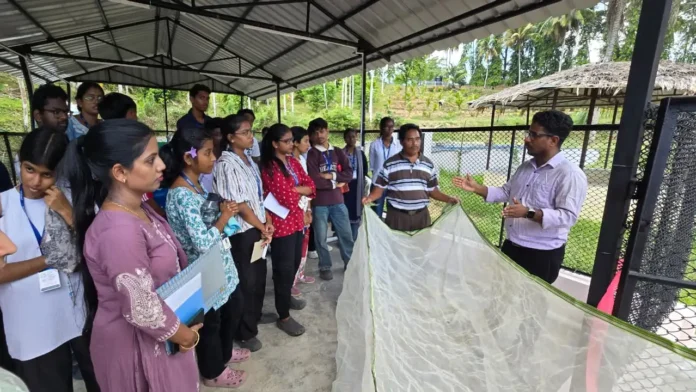
Sri Vijaya Puram (Port Blair), April 10: The ICAR-Central Island Agricultural Research Institute (ICAR-CIARI) conducted a sensitization programme on April 9 for 30 students and faculty members from the Zoology Department of Jawaharlal Nehru Rajkeeya Mahavidyalaya (JNRM), focusing on fisheries resources, aquaculture practices and emerging entrepreneurial opportunities in the Andaman and Nicobar Islands.
The programme aimed to provide academic exposure and practical insights into fisheries science and allied sectors. Scientists from ICAR-CIARI engaged participants through technical sessions and demonstrations, highlighting the economic and ecological significance of fisheries in the island region.
Head of the Fisheries Science Division, M. Muruganandam, outlined the scope of fishery resources in the islands and drew attention to the increasing demand for ornamental fish in recreational and decorative sectors. He explained that ornamental fish keeping has gained popularity among hobbyists and can contribute to stress relief while also offering income-generating opportunities.

He further discussed watershed-based fisheries, emphasizing the potential of water harvesting and fish farming systems suited to local conditions. Stressing productivity factors, he highlighted the importance of quality fish seeds, appropriate feed, water quality management and biomass optimisation to improve yields and economic returns in aquaculture.
Senior Scientist Praveenraj provided a detailed overview of ornamental fish species at the institute’s aquarium facility. He explained their biological traits, feeding patterns and breeding behaviour, noting that scientific understanding of these factors is critical for developing sustainable ornamental fish enterprises. He added that such ventures can open avenues for entrepreneurship in the region.
Scientist Chittranjan Raul focused on aquaculture techniques, particularly carp breeding, seed production, feeding strategies and water quality management. He explained that these practices are essential for ensuring consistent production and long-term sustainability in fish farming operations.
The programme also involved technical staff, including Chandan Kumar and Sonia, along with other members of the Fisheries Science Division, who supported the sessions and demonstrations.
In addition to fisheries, the Natural Resource Management Division of ICAR-CIARI conducted demonstrations on vermicomposting. Scientists highlighted its role in sustainable agriculture and explained how it can be developed into a viable entrepreneurial activity.

Participants engaged in interactive discussions with scientists, gaining practical exposure to agro-technologies, agrotourism prospects and alternative livelihood opportunities beyond conventional food production systems.
The session was coordinated by Vivek Kumar Sahu, Assistant Professor, and S Pushpa Lata, Guest Faculty of JNRM. Faculty members and students acknowledged the programme as an informative initiative that provided hands-on learning and insight into emerging sectors within agriculture and allied fields.
The initiative reflects efforts to bridge academic learning with field-level applications and to promote skill development and entrepreneurship among students in the island region.