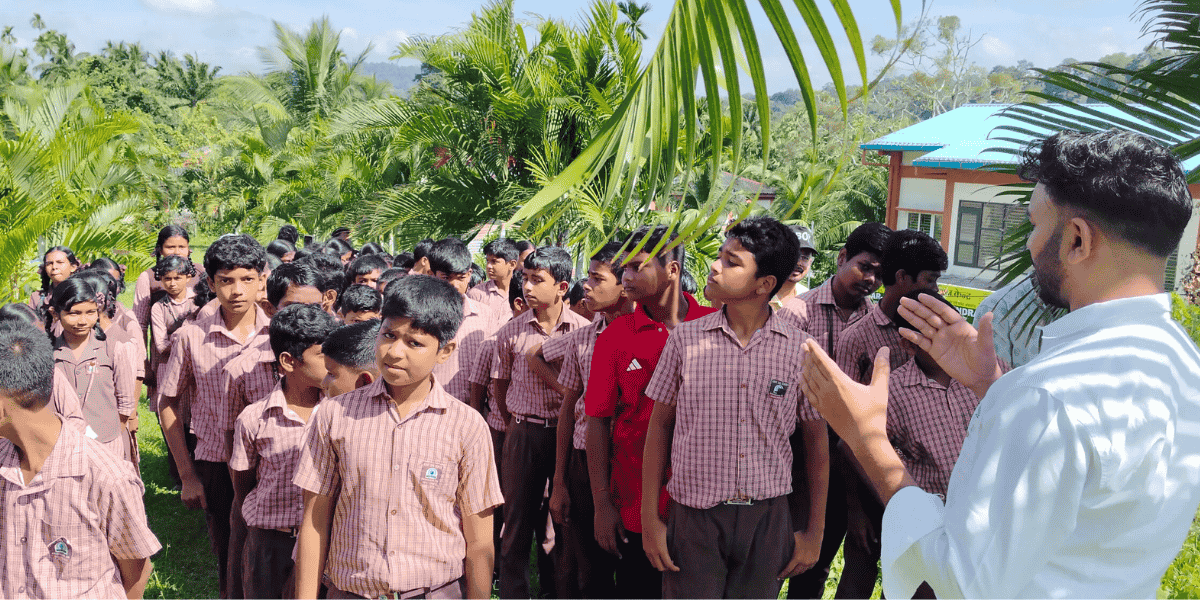
Students from GSS Pinakinagar visited the ICAR-Krishi Vigyan Kendra (KVK) in North and Middle Andaman on 25 November 2025 as part of an educational exposure tour aimed at introducing them to practical aspects of agriculture and allied sectors. The visit was organised to offer young learners firsthand insight into farming technologies, integrated agricultural systems and the role of scientific institutions in supporting rural development.
At the beginning of the visit, the students were received by Rakesh Dawar, Subject Matter Specialist in Agronomy, who briefed them on the KVK’s core functions and familiarised them with the facilities available at the centre. The students were taken through various demonstration units, including crop cultivation models, fisheries units, mechanised farming tools, integrated farming system setups and vermicomposting structures. Through these interactions, the students were introduced to modern agricultural techniques, climate-resilient practices and the relevance of sustainable farming for ensuring long-term food and nutritional security.

During the session, Dawar explained how demonstration units help farmers understand new technologies more effectively than classroom-based instruction. He highlighted how mechanisation, improved crop management, better soil practices and integrated farming can increase productivity even in geographically constrained island regions. Students were able to observe real-time examples of innovative approaches such as diversified cropping, water-efficient irrigation models and organic nutrient management.
The students also attended a detailed interaction led by Yatharth Sharma, Subject Matter Specialist in Home Science. Sharma outlined the mandate of Krishi Vigyan Kendras and explained their role in taking scientific advancements directly to farming communities. He elaborated on the KVK’s major activities, including technology dissemination, training programmes, frontline demonstrations and welfare initiatives designed for farmers and rural youth.
Sharma further discussed the growing opportunities in agriculture and allied sciences, pointing out that agriculture now encompasses a wide range of emerging fields such as agri-entrepreneurship, food processing, agricultural engineering, animal husbandry, aquaculture and rural technology services. The role of science and innovation in enhancing farm incomes and improving rural livelihoods formed a significant part of his interaction. He also underlined the growing importance of skill development among young people who may consider agriculture as a viable and fulfilling career path.
Throughout the visit, students were exposed to practical examples of research-based technologies adapted specifically for island conditions. These included pest and disease management tools, climate-resilient crop varieties, integrated farming modules combining livestock, fishery and crop cultivation, and improved composting techniques. By observing these systems directly, the students gained a clearer understanding of how scientific institutions contribute to solving real-world challenges in agriculture.

The educational trip aimed not only to create awareness but also to stimulate interest in agriculture among school students, many of whom may have limited exposure to modern farming practices. Teachers accompanying the group noted that such visits help bridge the gap between textbook knowledge and field-level application, especially in regions where agriculture forms an important part of local livelihoods.
The programme was conducted under the overall guidance of Jai Sunder, Director (Acting) of ICAR-CIARI, Sri Vijaya Puram. A total of 65 students and teachers participated in the visit, which provided them with a comprehensive view of the scientific, practical and career dimensions of modern agriculture. As the students concluded their tour, the institution expressed hope that the exposure would encourage more young learners to engage with agricultural sciences and contribute to future development in the sector.