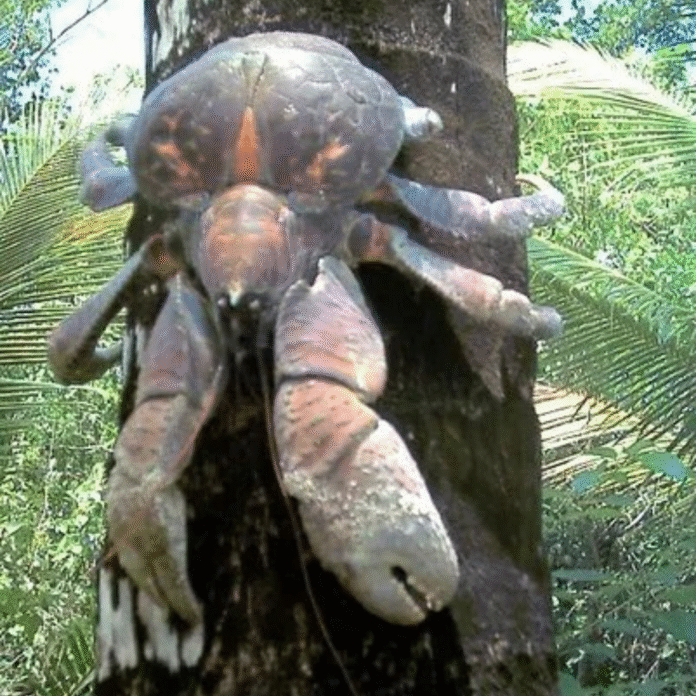
Sri Vijaya Puram, May 24: Known for its unusual size, strength, and sneaky habits, the Giant Robber Crab, also called the Coconut Crab, is turning heads in the forests of Campbell Bay National Park. Considered the world’s largest land-living crab, this rare species is found only in the Great Nicobar Biosphere Reserve and has become both a biological marvel and a tourist curiosity.
According to Dr. Kailash Chandra, former Director of the Zoological Survey of India, Eastern Region, the crab’s nickname comes from its tendency to “rob” unattended food, using its keen sense of smell to detect fruits, seeds, and even leftovers from humans. Despite its name, coconuts are not its main food source, it prefers softer fruits and carrion.
Forest officials and zoologists note that the Robber Crab is also a strong climber. It is often seen scaling trees not just for food but also to escape predators when far from its burrow. The crab can grow up to 40 cm long, weigh 4.5 kg, and stretch its legs over one meter. Its powerful claws can break open hard shells, and the larger left claw is especially adept at cracking tough items.
“These crabs start life in the ocean,” Dr. Kailash told The Wave Andaman. Females lay eggs along the shore, which hatch into larvae. After floating at sea for weeks, the young crabs settle on the ocean floor, find a shell, and eventually move onto land.” As they mature, they outgrow the need for borrowed shells and develop a protective exoskeleton.
Adapted fully to land, adult Robber Crabs cannot survive underwater for long. They breathe through specialized organs like lungs, making prolonged submersion fatal. The species typically reaches sexual maturity around age five, and can live up to 60 years.
Juveniles use snail shells for protection, much like their close relatives, the hermit crabs. However, the Robber Crab is the only species in its genus, and is classified as a T4 terrestrial animal, meaning it lives entirely on land but still requires the sea to complete its life cycle.
Though usually nocturnal and solitary, female Robber Crabs carrying eggs are sometimes seen in larger numbers near coastal areas. Their behavior may vary with environmental conditions and human activity. Alongside other endemic species like the Nicobar pigeon and the crab-eating macaque, the Robber Crab plays a crucial role in maintaining the island’s biodiversity.
So, if you ever find a piece of fruit missing in the dense forests of Great Nicobar, it may just be the Robber Crab, climbing trees, scavenging, and thriving as one of nature’s most curious climbers.