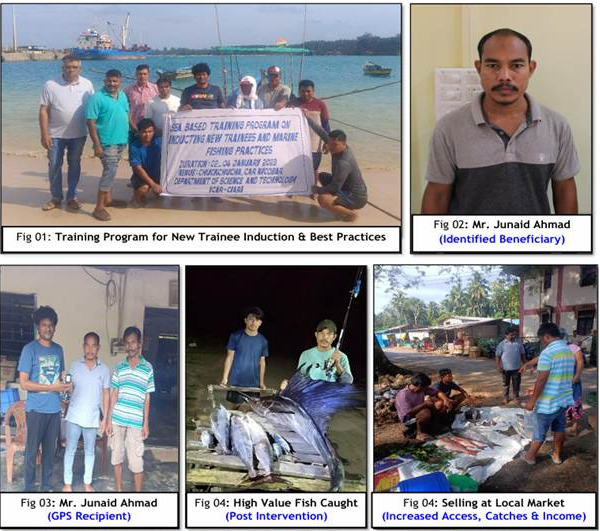
A pilot technology initiative introducing Global Positioning System devices among tribal fishers in Car Nicobar is beginning to transform traditional fishing practices, improving catch volumes and livelihoods for local communities. The intervention, implemented under a programme of the Department of Science and Technology, aims to integrate navigation technology into the island’s small-scale fisheries sector.
Fishing remains the primary livelihood for many Nicobarese families, with generations relying on inherited knowledge of tides, seasonal fish movements and weather patterns. While these traditional techniques have sustained the community for decades, the absence of precise navigation tools often made fishing unpredictable. Sudden weather disturbances and limited orientation in open waters sometimes caused boats to drift off course, affecting both productivity and safety.
To address these challenges, the Central Island Technological Research Institute introduced GPS devices designed to suit the local marine environment and the fishing practices of Nicobarese communities. The initiative was carried out under the Science for Equity, Empowerment and Development (SEED) Division programme of the Department of Science and Technology.
Under the project, fishers received training on GPS navigation and modern fishing techniques to enable them to effectively use the technology at sea. Surveys were conducted to understand the specific needs and challenges faced by local fishers before the devices were introduced. The adoption process was further supported through engagement with the tribal council, which helped promote the use of the technology within the community.
The GPS devices allow fishers to accurately mark productive fishing grounds and navigate directly to them during subsequent trips. This has reduced the time spent searching for fish while improving the chances of reaching areas known to yield good catches. As a result, fishing trips have become more efficient, enabling fishers to spend less time at sea while returning with larger catches.
According to information released under the programme, the introduction of GPS technology has significantly improved fishing productivity. Fishers have reported an average increase of about 168 per cent in their daily catch volume after adopting the navigation devices. The improved efficiency has also meant fewer wasted trips and greater predictability in fishing activity.
The initiative has begun to create new economic opportunities within the community. Some fishers have started selling part of their catch in local markets, generating additional income for their households. Individuals from villages such as Teetop and Chuchucha are among those who have begun marketing surplus fish after meeting family consumption needs.
A coastal fisheries information hub has also been established on Car Nicobar Island to support the initiative and serve as a knowledge centre for fishers. Under the project, five GPS devices were distributed to tribal fishermen, while another five units have been kept for shared use among the fishing community.
Beyond income gains, the initiative is also contributing to improved nutrition in the community. With larger and more consistent catches, families have increased access to fresh fish, an important source of protein and essential nutrients in island diets. The availability of surplus fish has also allowed households to diversify their food consumption.
Officials involved in the programme say the initiative demonstrates how appropriate technology can complement traditional knowledge systems in remote island communities. By combining local experience with modern navigation tools, the project aims to strengthen both the economic resilience and food security of the Nicobarese fishing community.
The experience in Car Nicobar is being viewed as a model that could potentially be expanded to other coastal and island regions where small-scale fishers face similar challenges in locating fishing grounds and navigating changing sea conditions.