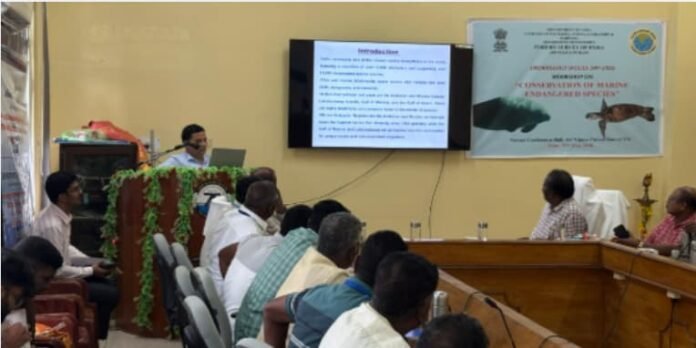
Sri Vijaya Puram, May 16: The Fishery Survey of India (FSI), Sri Vijaya Puram, organised a one-day workshop on the theme “Conservation of Marine Endangered Species” on Thursday to mark Endangered Species Day 2026.
The workshop was held at the FSI Conference Hall and focused on issues related to marine biodiversity conservation, protection of endangered marine fauna and sustainable management of marine resources within the Indian Exclusive Economic Zone (EEZ).
The programme witnessed participation from fishermen, students of Pondicherry University, officials from the Fisheries Department and representatives from scientific and research institutions.
Fishermen from Puducherry also attended the workshop and took part in discussions related to marine conservation and field-level challenges faced during fishing activities.

The programme began with a welcome and introductory address by C. Babu, who spoke about the significance of Endangered Species Day and the importance of monitoring marine biodiversity.
He highlighted the role of the Fishery Survey of India in conducting marine surveys and documenting marine mammals and endangered marine species in Indian waters.
B. Balanayak delivered the keynote address during the workshop and discussed the need for collective efforts towards conservation of marine ecosystems and sustainable utilisation of marine resources.
Govindasamy attended the programme as the guest of honour and spoke about the need for awareness, policy support and participation of fishing communities in protecting endangered marine species.
Nesnas also attended the event and suggested that similar awareness programmes could be conducted separately for departmental officials.
The chief guest of the programme, M. Muruganandam, presented a technical paper on “Endangered Aquatic Species Conservation and Management”.

During the presentation, he discussed conservation challenges affecting aquatic biodiversity, ecosystem restoration efforts and the importance of community participation in protecting endangered species.
The presentation also highlighted endangered marine and aquatic species found in the Andaman and Nicobar Islands along with factors contributing to their declining populations.
Topics including legal protection measures, conservation guidelines and national and international initiatives related to endangered species protection were also discussed during the technical session.
Mrinal Kumar Das delivered another technical presentation on “Endangered Marine Species of India”.
The session focused on threatened marine mammals, sea turtles, sharks, rays and other vulnerable marine fauna found in Indian waters.
Participants were informed about ecological threats including habitat degradation, overfishing, marine pollution, climate change and accidental entanglement of marine species in fishing gear.
An interactive session was also conducted during the workshop where fishermen shared field observations and experiences related to sightings of endangered marine species in fishing areas.
Participants also discussed practical challenges connected with marine conservation and sustainable fishing practices.
Marine biodiversity conservation remains an important issue in the Andaman and Nicobar Islands due to the region’s rich coral reef ecosystems, mangroves and diverse marine life.
Scientists at the workshop stressed the importance of balancing marine resource utilisation with conservation efforts to reduce pressure on vulnerable marine species. The programme concluded with a vote of thanks proposed by Puran Singh.