When news broke that Mexican cartel leader Nemesio Ruben Oseguera Cervantes, known globally as El Mencho, had been killed in a military operation, the immediate concern was the fallout in Latin America. But inside Indian security agencies, the development revived memories of a case that had quietly redrawn the country’s narcotics map.
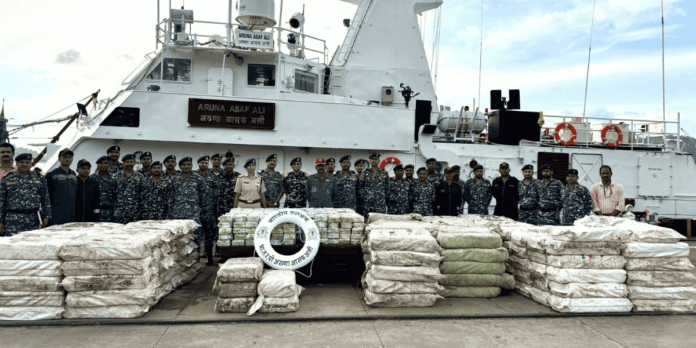
That moment came in 2024, when a massive drug consignment was intercepted near the Andaman and Nicobar Islands. What began as a maritime seizure soon evolved into a warning that international trafficking networks were no longer merely passing near Indian waters, they were beginning to treat the Andaman Sea as a workable link in a global supply chain.

The interception
The operation began when a suspicious vessel moving through the Andaman Sea drew attention from maritime surveillance teams. Boarding officers discovered not only a huge quantity of synthetic drugs but also satellite communication devices and navigation systems that suggested the route had been carefully plotted.
For investigators, the consignment’s scale immediately raised questions. This was not a shipment intended for small local distribution. Officials suspected it was part of a larger regional pipeline. What strengthened that view was the discovery that the vessel had entered specific island coordinates into its navigation system, indicating traffickers were studying the geography rather than simply passing through.
The Andaman chain’s location explains the attraction. The islands sit barely a few hundred nautical miles from Myanmar and Thailand and lie close to the maritime approaches to the Golden Triangle, the long-standing narcotics production zone spanning Myanmar, Laos and Thailand. Synthetic drugs from labs in that region increasingly move by sea to avoid land-border crackdowns, making the Andaman Sea a natural corridor between production zones and onward markets.
The network
As interrogation and intelligence analysis progressed, investigators began tracing signs of a broader structure behind the consignment. Security officials familiar with the probe say there were indications that Latin American suppliers were linked with China-linked facilitators handling logistics across Asia, while Myanmarese intermediaries and crews managed the transport phase.
Such a layered model was markedly different from earlier narcotics flows affecting India, which were often dominated by regional syndicates. The Andaman case instead suggested a modular supply chain where production, financing, transport and distribution were spread across jurisdictions.
For agencies, the implication was clear: the islands were being evaluated not just as a transit patch but as a strategic node connecting Golden Triangle production zones, Southeast Asian markets and global trafficking networks. In that context, the Andaman Sea’s position near major shipping lanes only increased its value for traffickers seeking routes that blend into legitimate maritime traffic.

The police response
Officers involved in the case say the seizure might have ended as a dramatic but isolated success had it not been pursued differently on the ground. Under Director General of Police Hargobinder Singh Dhaliwal, the Andaman and Nicobar Police treated the haul as the starting point of a larger intelligence exercise rather than the conclusion of an operation.
Police teams were tasked with mapping potential landing points across the islands, tracing communication trails recovered from the vessel and examining whether traffickers had identified local contacts or intended drop zones. Coordination with central agencies and maritime forces was strengthened so that the investigation could generate route intelligence instead of stopping at arrests.
Officials say this approach helped agencies understand that traffickers were actively testing the corridor, studying navigation methods, measuring enforcement response times and assessing whether the island geography could sustain future consignments.
The killing of El Mencho may temporarily unsettle parts of the global supply chain linked to such routes. But officers caution that trafficking systems rarely collapse with individual cartel leaders. Routes that prove profitable tend to survive, often with new intermediaries stepping in.
For Indian security planners, the lesson from the Andaman episode remains stark. The islands sit at the meeting point of the Golden Triangle, Southeast Asian shipping lanes and Indo-Pacific trade routes, and how firmly that maritime space is policed will determine whether it remains a contested frontier or hardens into a permanent corridor in the global narcotics trade.