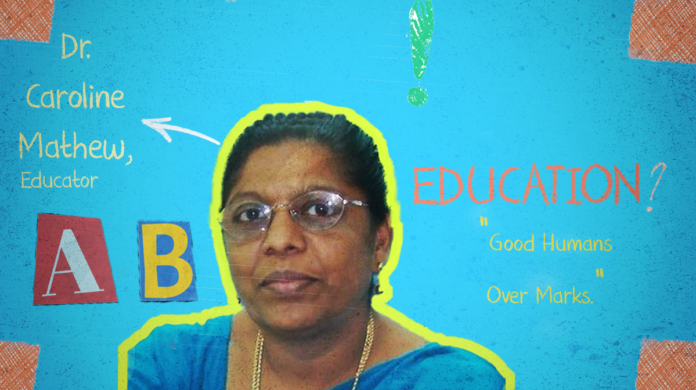
Sri Vijaya Puram: Noted educationist from the islands, Dr. Caroline Mathew, feels that the core purpose of education in Andaman and Nicobar is slowly being pushed aside in favor of commercial interests. With over four decades in the classroom, across primary and secondary levels, in remote and urban areas, she has witnessed first-hand how the classroom has changed. From the overuse of mobile phones to the sidelining of NCERT books and the growing pressure on teachers, she believes the system needs a reset. In a conversation with The Wave Andaman’s Rashmi Rao, she talks about the deeper shifts she has seen in the islands’ education ecosystem and why a more grounded, student-centric approach is the need of the hour. Edited Excerpts.
You started teaching in the early 1980s. What was it like to teach in those days compared to now?
Back then, teaching felt more purposeful. Students were more focused, and there was mutual respect between teachers and learners. I began teaching in 1980 after completing my B.Ed. At first, I taught grades 3 to 5 at Model School. Later, I moved into higher grades. Even in remote places like Long Island, where children had little exposure to the outside world, they were eager to learn. Today, attention spans are much shorter. Students are distracted by devices and lack basic language skills. The learning environment has changed completely.
Many schools in the islands now prioritize private publishers over NCERT books. What’s driving this shift, and what does it mean for parents and students?
This is one of the major issues at present. Schools are choosing books not for their content but for the commissions they bring. Some book sellers offer ₹15–30 lakh in incentives. This creates a monopoly and increases the financial burden on parents. Worse, many teachers aren’t trained to teach from these books, which affects classroom quality. It’s turned education into a profit-making exercise.
The pandemic pushed schools into online mode. But even today, many rely heavily on WhatsApp or mobile-based teaching. Is that helping or hurting students?
It’s mostly hurting. During the lockdown, online teaching was necessary. But now, it’s being misused. Some teachers just send notes on WhatsApp. Students browse, skim, and move on. There’s no real engagement or understanding. Technology can be a tool, but it can’t replace the teacher-student connection that makes learning meaningful.
Reading habits among students seem to be in decline. What’s going wrong?
Reading is the foundation for language, imagination, and thinking. Today, that habit has almost disappeared. Students may say “yeah, yeah” or use trendy phrases, but they struggle with sentence construction and grammar. Earlier, we used to gift books, save money to buy and share them. That culture is fading. And teachers, overburdened with admin work and online tasks, don’t have time to encourage reading in class.
Frequent transfers and bureaucratic controls have long been challenges for teachers in the islands. How does that affect teaching?
Transfers create instability. Teachers live in uncertainty. Families are split, and morale drops. Add to that the constant paperwork, inspections, and documentation—there’s barely any room left for actual teaching. The focus is on ticking boxes, not on student growth. Every island is different, and we need policies that reflect that. We need fewer reports and more real planning.
What needs to change to make education in the islands more meaningful again?
We need to shift the focus back to students, real classrooms, trained teachers, and consistent engagement. Value education is missing. Coaching centres and schools chase marks, but ignore basic values like empathy, humility, and integrity. Parents must also be more involved—talking to their children, reading with them, and reducing screen time. Education must be about character as much as academics.